
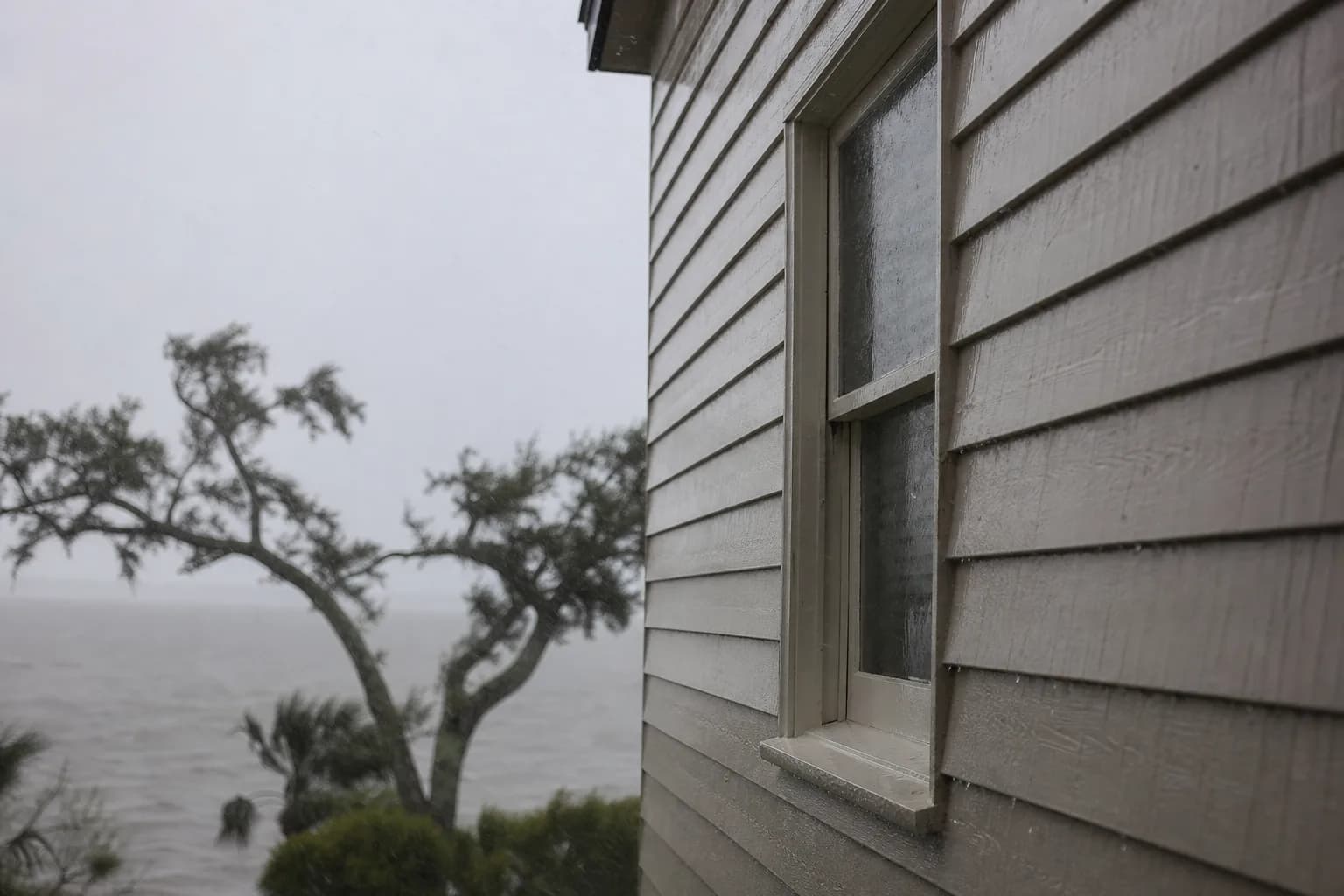
The siding did its job in every ordinary rain for years. Then a Gulf storm came through sideways, and a week later there's a stain bleeding down the inside of the wall under the bedroom window. Nothing changed about the paint. What changed is the wind. Wind-driven rain doesn't behave like the rain your siding was built to shed — it gets pushed up, sideways, and into the wall through gaps a calm shower would never find. On the coast, where storms arrive with real force several times a year, that's the difference between siding that stays dry and siding that quietly fills with water behind a perfect-looking finish.
This is about the mechanics: how the wind actually pushes water past your siding, the exact joints it exploits, and the flashing and sealing that stop it. It's the companion to the question of where moisture behind exterior paint comes from — that post maps every moisture source; this one zooms in on the one that does the most damage in a single afternoon.
Why does wind-driven rain get behind siding when normal rain doesn't?
Answer first: siding sheds water that falls down, but wind-driven rain doesn't fall down — it's pushed sideways and even upward against the wall, and the wind itself creates a pressure difference that physically forces water through any opening. Two things are working at once, and both matter.
First, the angle. Lap siding, trim laps, and shingle courses are designed to overlap so gravity carries water down and off the face. When rain hits at 30 or 40 degrees off vertical, it drives under the bottom edge of a lap and up behind the course above — exactly the direction the overlap can't protect against. Brick and stucco shed straight rain, too; angled rain hits the joints differently.
Second, and the part most people never picture, is pressure. A gust hitting the windward wall raises the air pressure right at the surface. The wall cavity behind the siding is at a lower pressure. Air — and the water riding in it — moves from high pressure to low, so the storm doesn't just splash the wall; it actively pushes water through every gap toward the inside. That's why driven rain gets behind siding that sheds a downpour without a problem. The wind is pumping it in.
The gaps it exploits: where driven rain enters
Driven rain doesn't come through the open face of a board. It comes through the seams and transitions — the spots where the shedding stops and a joint begins. These are the usual entry points, in rough order of how often we find them leaking on coastal homes.
| Entry point | Why water gets in here | What stops it |
|---|---|---|
| Window and door heads | No head flashing, or it's rusted/missing — water sheets in above | Proper head flashing over the trim, not just caulk |
| Bottom laps and butt joints of siding | Driven rain pushes up under the lap and behind end joints | Sound boards, sealed butt joints, open drainage at the bottom |
| Inside and outside corners | Corner boards and miters open up and channel water in | Tight corner detail, flashing or sealant at the joint |
| Where two materials meet | Siding-to-brick, siding-to-trim, wall-to-roof transitions move and crack | Flashing at the transition plus a flexible sealant joint |
| Penetrations (lights, bibs, vents) | Anything poking through the wall is an unsealed hole | A flashed or sealed mount, sealant rated for movement |
Notice the pattern: every one of these is a place where the siding's natural shedding is interrupted. That's also why the failure usually shows up lower than where the water got in. Rain enters at a window head or a bad corner, runs down inside the wall, and surfaces as a stain or peeling a course or two below — or a whole story below — the real opening. We trace failures back up the wall for this reason, the same way we do when diagnosing peeling and blistering on a coastal home.
What stops it: flashing, sealing, and open drainage
Here's the part that trips homeowners up most, so it's worth stating plainly: stopping driven rain is not about sealing the wall airtight. It's about sealing the joints water enters while leaving open the paths water needs to exit. Get that backwards — caulk the bottom edges of your siding to "keep rain out" — and you trap every drop that does get in, which rots the wall from the inside.
Three things work together:
Flash the big water paths
Flashing is the heavy lifter — metal or membrane that physically directs water out and away from windows, doors, rooflines, and deck-to-wall transitions. A missing or rusted window head flashing is the single most common driven-rain leak we find. Flashing belongs over the trim and behind the siding above it so water lands on top of it and runs out, not behind it. This is carpentry, and it lasts for decades when it's done right.Seal the joints that aren't meant to drain
Caulk the seams where wind-driven rain enters but water isn't supposed to pass — where trim meets siding, around window and door frames, at corner boards, and where dissimilar materials meet. Use a quality exterior sealant rated for joint movement, over a clean primed surface, and re-check it every few years because sun and salt air age it. This is the upkeep layer.Leave the drainage and weep paths open
Do not seal the bottom edges of lap siding, the bottom of window and door trim, or the weep paths in brick. Those gaps exist so any water the storm pushes in can drain back out and the cavity can dry. Sealing them traps moisture and guarantees rot. Stopping intrusion means controlling where water goes, not blocking every opening.
The caulking side has its own rulebook — which joints to seal, which to leave open, and the products that hold up in salt air — and we lay it out fully in where to caulk a Gulf Coast exterior. The flashing side is carpentry: when a window head has no flashing or the wood behind a leaking corner has gone soft, sealant can't fix it. That's a carpentry repair to rebuild the detail and replace any rotted board, so there's sound, dry material to seal and paint over.
Coastal homes take this harder — and storm season makes it worse
A house in our climate faces driven rain far more often, and far harder, than one inland. Storms roll off the Gulf with sustained wind behind the rain, salt air degrades caulk and rusts flashing faster, and the constant humidity means a wall that takes on water stays damp long enough to rot rather than drying between rains. An opening that would be a minor nuisance in a dry climate becomes an active leak here, several times a year.
That's why we treat the wall as a weather system before storm season, not after a leak shows. Checking and renewing the flashing and sealant, replacing any soft wood, and repainting over a tight wall is a core part of getting a coastal home ready for hurricane season. It's a lot cheaper than tearing into a wall to chase rot you let run for two seasons. For the full picture on protecting an exterior in this climate, our exterior house painting guide for Mobile and Baldwin County ties the flashing, sealing, prep, and paint together.
Stop the water before you blame the paint
Wind-driven rain gets behind your siding because storms don't fall straight down — they push rain sideways and up, and the wind's pressure forces water through the seams your siding can't shed at. It enters at window heads, bottom laps, corners, material transitions, and penetrations, then runs down inside the wall and surfaces as a stain or peeling below. The fix is a system: flash the big water paths, seal the joints that aren't meant to drain, leave the drainage paths open, and only then paint. Skip the flashing and sealing and the freshest coat in the world lifts by next storm season.
Seeing water marks, soft wood, or paint failing under a window after a hard rain? Book a free on-site estimate and we'll find exactly where the wind is driving water in, tell you straight what's sealant versus carpentry, and put a number in writing within 24 hours — backed by our 3-year workmanship warranty. Pro 1 Painters is family-owned, in business since 2013, with offices in Mobile and Spanish Fort. You pay by Cash, Check, or Credit Card.