
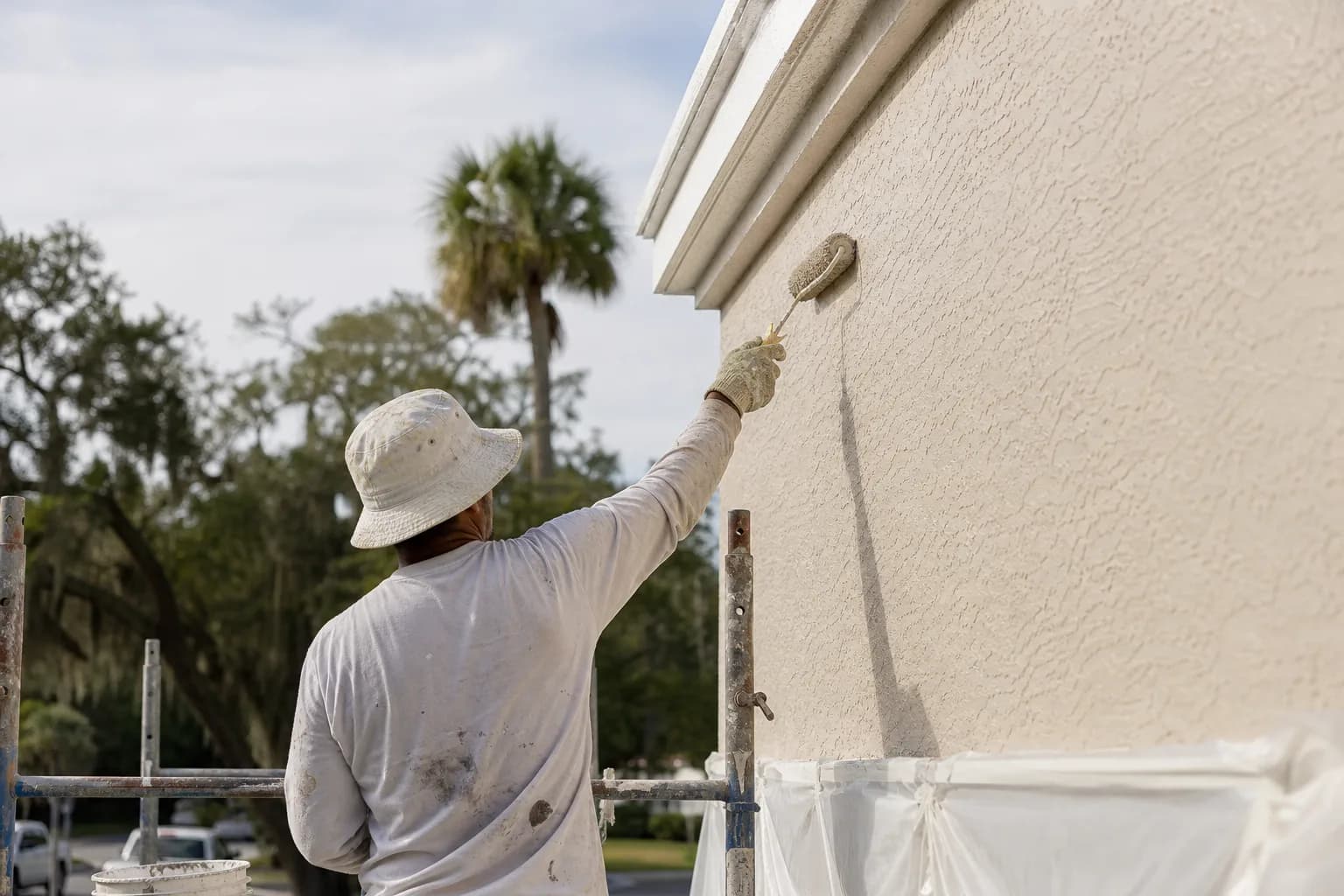
A stucco wall on the Gulf Coast lives a hard life. It bakes in the summer sun, soaks through humid nights, and takes wind-driven rain straight to the face every storm season. So when it's time to repaint, the question isn't just color — it's what kind of paint the wall actually needs. The two real contenders are standard acrylic and elastomeric, and picking wrong costs you either money you didn't need to spend or a finish that fails early.
Here's the short version: acrylic and elastomeric are both good products, but they solve different problems. The right call for your stucco depends on its condition, how exposed it is, and whether cracks keep coming back. Let's break down how each one works in this climate so you can spend on the wall you actually have.
Not sure which your wall needs? Our stucco & masonry painting starts by reading the wall, then matches the finish to it.
Elastomeric vs acrylic paint: how each one works on stucco
Start with what they are, because the names hide a big difference.
Standard exterior acrylic is a water-based paint that goes on relatively thin, dries to a flexible film, breathes well, and renews the color and a layer of weather protection. It's the workhorse of exterior painting for a reason — it's proven, it recoats cleanly years later, and a quality acrylic stands up well to sun and rain.
Elastomeric is a different animal. It's a thick, rubbery, high-build coating — many times the thickness of ordinary paint per coat. That heavy film does two things acrylic can't do as well: it stretches across hairline cracks instead of splitting over them, and it forms a tough waterproof shell that sheds wind-driven rain. The trade-off is that it costs more, takes more material and labor to apply right, and is harder to recoat or strip later.
| Factor | Standard Acrylic | Elastomeric |
|---|---|---|
| Film thickness | Thin, standard build | Very thick, high build |
| Crack bridging | Minimal — patch cracks first | Bridges hairline cracks, flexes with the wall |
| Wind-driven rain | Good water resistance | Excellent — forms a waterproof shell |
| Breathability | Higher — dries quickly | Lower — needs dry, sound stucco |
| Recoat / repaint later | Easy to recoat | Harder to recoat or remove |
| Relative cost | Lower | Higher (more material + labor) |
Neither column is "the winner." The winner is whichever one matches the wall in front of you.
When elastomeric earns its cost on the Gulf Coast
Elastomeric makes the most sense when water and cracking are your real problems — and on the Gulf Coast, they often are.
If your stucco shows recurring hairline cracks no matter how many times they get patched, elastomeric's flexible film is built for exactly that. It bridges those fine cracks and moves with the wall through the daily heat-and-cool cycle instead of telegraphing every line back through the finish. And if you've got walls that take wind-driven rain head-on — an exposed elevation, a tall commercial facade, a building near open water — the waterproof shell is genuinely worth it.
There's a catch, and it's a big one in this climate: elastomeric only works over sound, dry, well-prepped stucco. Because the film is thick and slows drying, putting it over damp stucco — or a wall with a moisture source behind it — can trap water and cause peeling. Gulf-Coast humidity makes "dry enough" a real judgment call, not a guess. If you're still weighing whether your wall is even a candidate, when to use elastomeric coating and when not to lays out the green-light and red-flag walls. It also can't fix a cracking problem on its own — active cracks need to be addressed first, which is why our guide to stucco crack repair before painting is worth a read before you coat anything. That's why we check the wall, the existing coating, and the conditions before we ever recommend it. Stucco-heavy buildings show up across our commercial painting work in Mobile and Baldwin County, and elastomeric is one of the tools we reach for when the wall calls for it — not a default.
When standard acrylic is the smarter choice
For a lot of stucco, a quality acrylic is the better, more sensible call — and you shouldn't pay for elastomeric you don't need.
If your stucco is in good shape — sound, not actively cracking, not chronically wet — a premium acrylic gives you excellent color, solid weather protection, and a finish that breathes freely in our humidity. Acrylic dries faster, is more forgiving to apply, and is far easier to recoat when it's time for a refresh down the road. You're not locking the wall into a heavy film that's tough to redo.
Acrylic is also the practical pick when budget matters and the wall doesn't have a water or crack problem to solve. Spending elastomeric money on a healthy wall is spending for a problem you don't have.
The honest answer is that the paint matters less than the prep and the diagnosis. A correctly chosen acrylic over a properly prepped wall will outlast a premium elastomeric slapped over a dirty, damp, cracked one. For exterior work generally, the same rule drives every job we do — you can see how we approach it on our exterior painting page.
How we decide which one your stucco needs
We don't pick the coating from a catalog — we pick it from your wall. Here's how we walk it during your free estimate.
Read the stucco's condition
We check for hairline versus structural cracking, soft or hollow-sounding spots, chalking, and how the existing paint is holding up. Cracking that keeps coming back points toward elastomeric; sound stucco points toward acrylic.Check exposure and moisture
We look at which walls take wind-driven rain and sun, and we make sure the stucco is dry with no moisture source behind it. In Gulf humidity, dryness decides whether a thick elastomeric film is safe to use.Match the product to the wall
Exposed, crack-prone, or weather-beaten walls get elastomeric for its crack-bridging and waterproofing; sound, healthy stucco gets a quality breathable acrylic that's easier to maintain.Prep before anything goes on
We pressure-wash, remove failing paint, repair cracks, and prime where needed. This step matters more than the coating choice and is where a lasting finish is actually won.Apply it right for the climate
We coat in dry conditions at the correct thickness and number of coats so the finish cures properly and bonds to the wall instead of trapping moisture.
Get those five right and either product will serve you well. Get them wrong and neither will. When elastomeric is the verdict, how we apply elastomeric to stucco and masonry covers the two-coat, mil-spec process that actually delivers the crack-bridging and waterproofing.
So which paint should you choose for stucco?
If your Gulf-Coast stucco fights recurring hairline cracks or takes wind-driven rain on exposed walls, elastomeric is usually worth its higher cost for the crack-bridging and the waterproof shell. If the stucco is sound and you want easy maintenance and good value, a quality acrylic is the smarter, more flexible choice. And in every case, the prep — washing, crack repair, priming, and a dry wall — decides whether the finish lasts far more than the label on the can does.
The cleanest way to get the right answer for your specific wall is to have someone look at it. We'll read the stucco, check the exposure and moisture, recommend the coating that actually fits, and email you a written quote within 24 hours. It's a free in-home estimate, and you can pay by Cash, Check, or Credit Card. Reach out whenever your stucco's ready and we'll take it from there.