
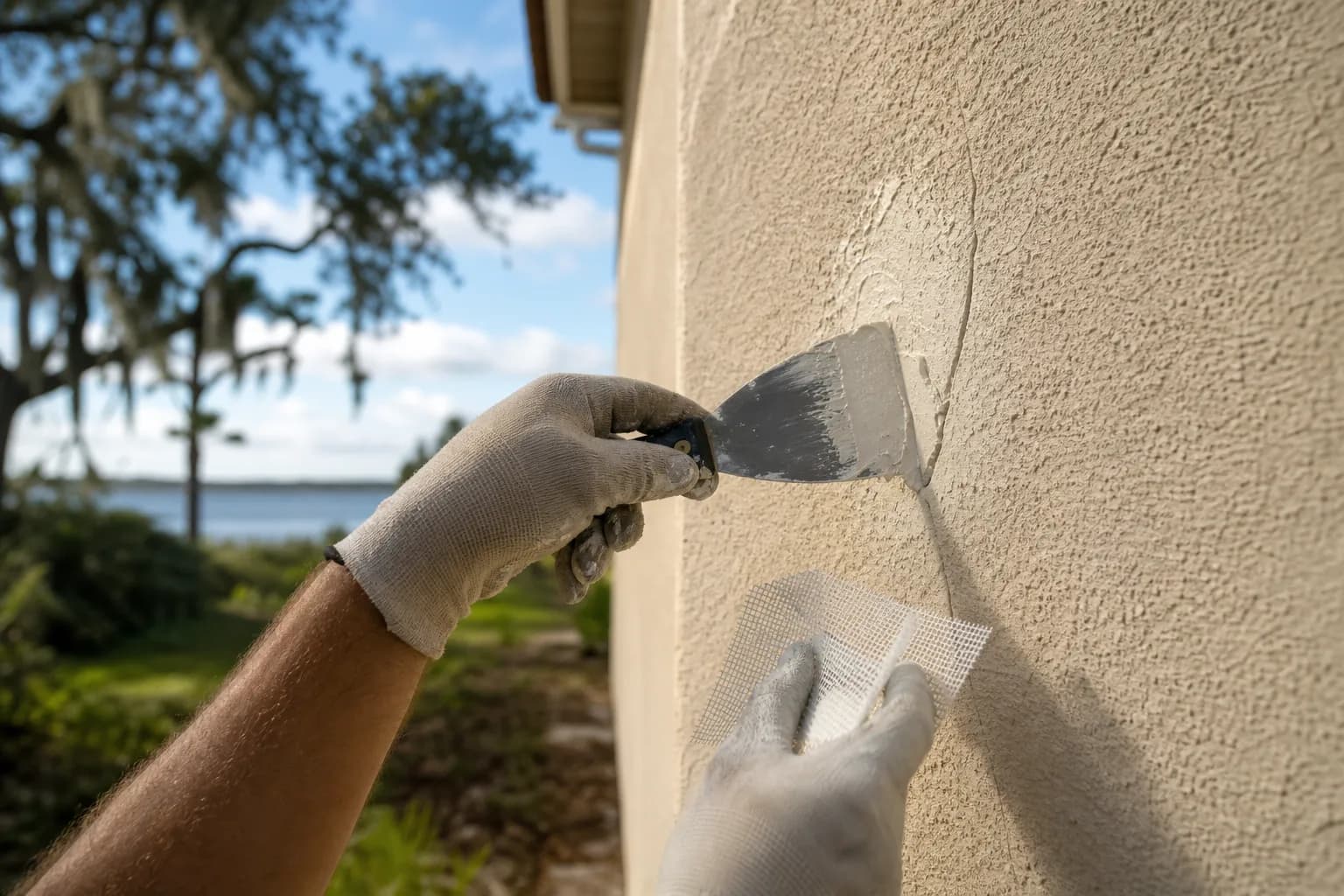
You can spot it from the driveway: a thin dark line running down the stucco off the corner of a window, or a web of fine cracks across a sun-baked wall. The temptation is to grab a can and paint right over it. Don't. On the Gulf Coast, an unrepaired crack is the single fastest way to wreck a fresh paint job — because that crack is exactly where wind-driven rain gets behind the wall, and no coat of paint stops water it's been painted over.
When you'd rather not DIY it, you can have us repaint your stucco start to finish — crack repair included.
Stucco crack repair before painting is its own job, separate from choosing a coating. Get the repair right and your finish lasts. Skip it and you'll be looking at the same line again next rainy season, this time with peeling paint feathered along both edges. Here's how to read a crack, fix it by size, and prep it so the paint actually holds in our climate.
Why stucco cracks matter so much before you paint
Stucco is a cement-based skin over your home, and it cracks for ordinary reasons: the house settles, the wall expands and contracts with our brutal temperature swings, and the stucco itself shrinks a little as it ages. A hairline crack on its own is cosmetic. The problem is what a crack does on the coast.
Every crack is an open door. During a Gulf storm, wind-driven rain doesn't just run down the face of the wall — it's pushed sideways into any opening it can find. A crack you can barely see with the naked eye is wide enough to wick water behind the stucco, where it soaks the wall, feeds rot in the framing, and builds the vapor pressure that later blisters and peels your paint from behind. Paint over that crack and you've sealed the entry shut on the surface while leaving it wide open underneath.
Diagnose the crack first: hairline vs. structural
Before you touch a tube of filler, figure out what kind of crack you're dealing with. The fix — and whether a fix will even hold — depends entirely on this.
| Crack type | What it looks like | What it needs |
|---|---|---|
| Hairline / shrinkage | Thin, shallow, often a fine web on the wall face | Open slightly, fill with elastomeric crack filler, texture, paint |
| Settlement crack | Wider line, often diagonal off a window or door corner | Rake out, patch with stucco compound, embed mesh, then paint |
| Active / structural | Wide, runs straight, keeps reopening after patching | Find the cause first — movement or moisture — before any patch will last |
| Pattern cracking + soft spots | Cracks plus hollow or crumbling stucco when tapped | Cut out and rebuild the failed stucco before refinishing |
Here's the field test we use: tap the stucco around the crack with a knuckle or the butt of a screwdriver. A solid, high-pitched sound means sound stucco you can patch. A hollow or dull sound means the stucco has delaminated from the wall behind it, and a surface patch won't hold — that section has to be cut out and rebuilt. Cracks that run dead-straight off a window or door corner, or that you've patched before and watched reopen, are telling you the wall is still moving. That's a movement or moisture problem to solve before a patch will ever last, and it's worth getting a professional eye on it.
How to repair stucco cracks before painting
Once you know what you've got, the repair itself is methodical. The goal is a patch that bonds to sound stucco, flexes with the wall, and matches the surrounding texture so it disappears under paint.
Diagnose the crack
Decide whether it's hairline, a settlement crack, or an active structural crack, and tap around it for hollow or loose stucco that won't hold a surface patch.Open and clean the crack
Widen hairline cracks slightly with a scraper or grinder so the patch has something to key into, then brush and blow out all dust and loose material down to sound stucco.Fill by crack size
Brush paintable elastomeric crack filler into hairline cracks; pack wider cracks with stucco patch compound, embedding fiberglass mesh in any crack that moves so the repair flexes instead of cracking again.Texture and cure the patch
Match the surrounding stucco texture while the patch is workable — a sponge, brush, or dab does it — then let it cure fully, a day or more in our humidity, before anything else.Prime and paint
Spot-prime every repair with a masonry primer so the patch doesn't flash through the topcoat, then paint the wall with a breathable coating in a dry weather window.
A few of these steps carry extra weight on the Gulf Coast. Mesh matters on any crack that moves — a strip of fiberglass mesh embedded in the patch spreads the stress so the repair flexes instead of splitting along the old line the first hot afternoon. Curing matters even more here: a patch that looks dry on the surface can still be damp underneath in our humidity, and painting over it traps that water and blisters the finish. We confirm a patch is hard and dry before priming, every time.
Repairing the crack vs. choosing the coating
It's worth being clear about where crack repair ends and paint selection begins, because they get tangled together. Repairing the crack — opening it, filling it, meshing it, curing it — is what we've covered here. Choosing what paint goes over the whole wall afterward is a separate decision, and on coastal stucco it's a real one.
That paint choice usually comes down to a breathable acrylic versus an elastomeric coating, and the right answer depends on how crack-prone and exposed your wall is. We break that decision down in detail in elastomeric vs. acrylic paint for Gulf Coast stucco, and if you're weighing whether an elastomeric coating fits your situation at all, when to use elastomeric coating and when not to walks through the trade-offs. The key thing to hold onto: even the best elastomeric coating is not a fix for an unrepaired, moving crack. Repair the crack as its own step, then pick the coating that suits the wall.
When should you call a professional for stucco cracks?
A handful of stable hairline cracks is a fair DIY weekend. Where it pays to bring in a crew is when the cracks are telling you something bigger. Recurring cracks, cracks running off every window corner, hollow-sounding stucco, or cracking spread across a whole elevation usually mean movement or trapped moisture — and a patch over a moving wall just reopens, taking your new paint with it.
That diagnosis is most of the job. Our exterior painting crews read the wall first — sounding for delamination, checking the crack pattern, and finding any moisture source — then repair and seal the cracks correctly before applying a coating built for our humidity. On larger stucco buildings, our commercial painting team handles the same work at scale, and for the full picture on protecting a coastal exterior, start with our exterior house painting guide for Mobile and Baldwin County.
The bottom line on stucco crack repair before painting: diagnose the crack, open and clean it, fill it by size with mesh where it moves, cure it fully, then prime and paint in a dry window. Do that and your finish sheds our rain instead of failing along the cracks. When you'd rather have it diagnosed and done right the first time, reach out for a free in-home estimate and a written quote within 24 hours. We're family-owned and have repainted Gulf Coast homes since 2013.