
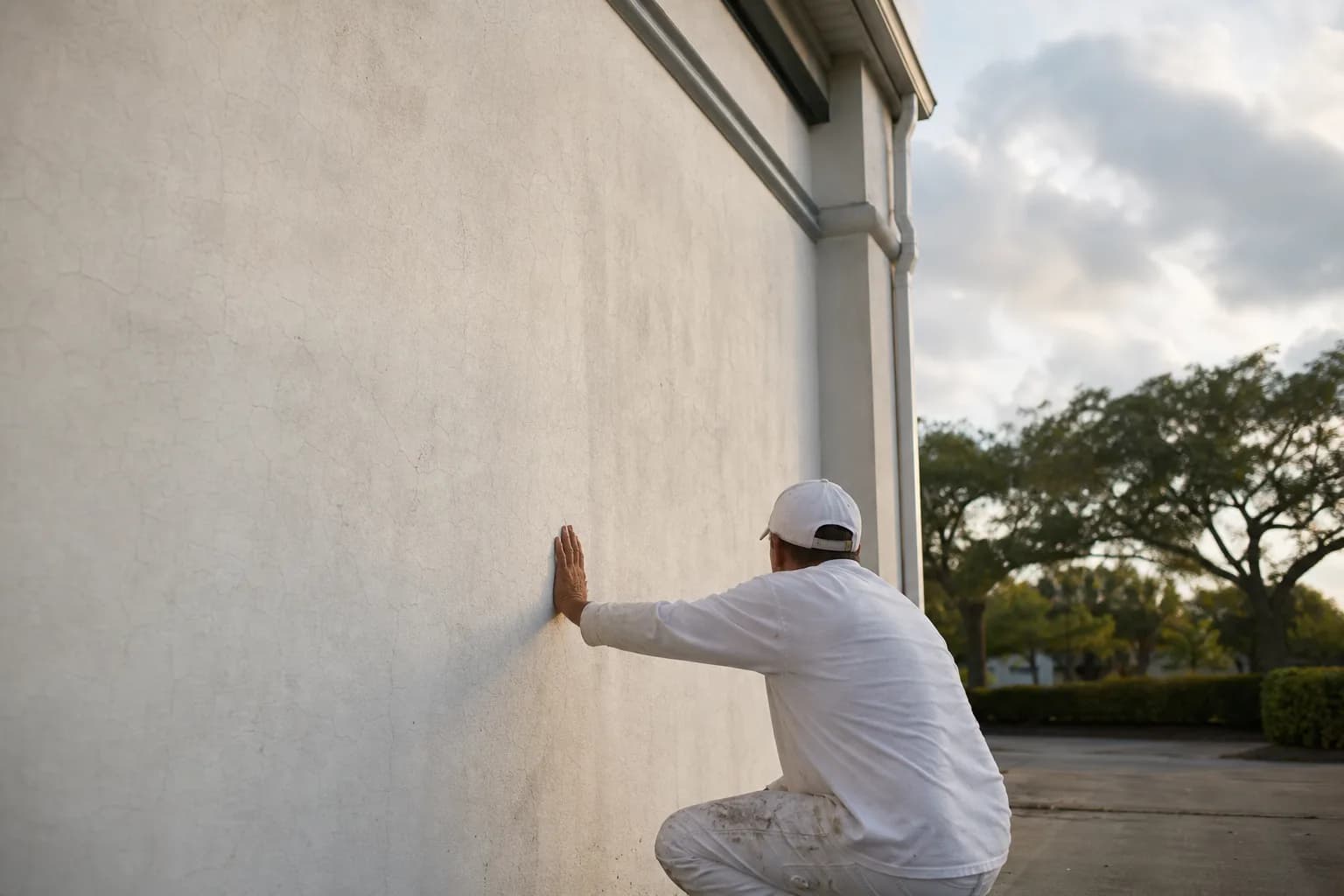
There's a coating that can waterproof a cracking wall and add years to a hard-exposed facade — and the same coating, put on the wrong wall, can seal moisture inside until the paint blisters off in sheets. That's elastomeric. It's one of the more powerful tools we carry for exterior work on the Gulf Coast, and also one of the easiest to misuse.
So the real question isn't "is elastomeric good?" It's narrower and more useful: when should you use elastomeric coating, and when should you walk away from it? Get that decision right and you protect the wall for years. Get it wrong and you create a moisture problem that's worse than the cracks you started with. Here's how we make the call on Gulf Coast walls.
What elastomeric coating actually does
Before you can decide when to use it, you have to know what it is. Elastomeric is a thick, rubbery, high-build coating — many times the film thickness of ordinary exterior paint per coat. That heavy, flexible film does two things standard paint can't do nearly as well: it stretches across hairline cracks instead of splitting over them, and it forms a tough shell that sheds wind-driven rain.
Those are real strengths. The catch is baked into the same property that makes it work: the film is thick, and thick films breathe slowly. On a dry wall, that's fine — the coating sheds rain from outside while the wall still releases vapor at a manageable rate. On a wall that's holding water, slow breathing turns into trapped moisture. That single trade-off drives the entire when-to-use-it decision, so keep it in mind for everything below.
When to use elastomeric coating
Answer-first: use elastomeric when a sound, dry, masonry-type wall has recurring hairline cracking or takes wind-driven rain on an exposed face. Those are the conditions where its crack-bridging and waterproofing pay for themselves — and on the Gulf Coast, plenty of walls meet them.
It earns its cost in a few clear situations:
- Recurring hairline cracks. If a stucco or masonry wall keeps developing fine cracks no matter how often they're patched, elastomeric's flexible film bridges them and moves with the wall through the daily heat-and-cool cycle instead of telegraphing every line back through the finish.
- Exposed, weather-beaten elevations. A wall that takes wind-driven rain head-on — a tall facade, a weather-facing side, a building near open water — benefits from the waterproof shell in a way a thin coat can't match.
- Tall commercial walls and parapets. Big, hard-working masonry surfaces that are expensive to access and repaint are good candidates, because the durable high-build film stretches the time between repaints. Stucco-heavy buildings show up all through our commercial painting work across Mobile and Baldwin County, and elastomeric is one tool we reach for when the wall calls for it. Once you've decided a wall is a fit, how we apply elastomeric to stucco and masonry walks through the prep and mil thickness that make it hold.
When should you NOT use elastomeric coating?
This is the part that saves you from an expensive mistake, so we'll be blunt about it. The thick, slow-breathing film that makes elastomeric great on the right wall makes it a liability on the wrong one. Walk away from elastomeric in these cases:
- Any wall that isn't dry. If the wall is damp, recently soaked, or hasn't had time to dry out after rain, a heavy film over it slows drying even further and seals the water inside.
- A wall with a moisture source behind it. A roof or flashing leak, plumbing behind the wall, or rising damp from the ground will keep feeding water into the wall. Coat over that and the moisture has nowhere to go but back through the paint — as blisters. Fix the source first, every time.
- Bare or unsealed wood and wood siding. Wood moves and breathes with the seasons; a low-breathing elastomeric film traps the moisture wood naturally exchanges and peels. Elastomeric is a masonry product, not a wood one.
- A wall already wearing a thick or failing film. Piling elastomeric onto a coating that's already heavy or letting go just builds a thicker problem. The old coating has to be sound, or removed, first.
Use it or skip it: the decision at a glance
Most walls sort themselves out fast once you line up the conditions. Here's the short version of how the call usually breaks down.
| The wall in front of you | Elastomeric? | Why |
|---|---|---|
| Sound, dry stucco with recurring hairline cracks | Use it | Crack-bridging is exactly what it's built for |
| Exposed masonry facing wind-driven rain, dry behind | Use it | The waterproof shell earns its cost on hard exposure |
| Wall with a leak or rising-damp source behind it | Skip it | Seals moisture in — fix the water first |
| Damp wall, or recently soaked and not dried out | Skip it | Thick film slows drying and traps water |
| Wood siding or bare wood | Skip it | Wood needs to breathe — use a flexible acrylic |
| Sound, dry wall with no crack or rain problem | Skip it | No problem to solve — a quality paint is smarter |
Notice the pattern: elastomeric is a problem-solver, not a default. When a wall has the specific problems it's built for and the conditions are safe, it's worth its cost. When either of those is missing, a quality breathable finish is the better, cheaper choice — and the head-to-head trade-offs are laid out in our elastomeric vs acrylic comparison for Gulf Coast stucco.
How we make the call on your wall
We don't choose the coating from a catalog — we choose it from the wall, during your free estimate. Here's the order we work through.
Rule out a moisture source first
We check for active leaks, staining, efflorescence, rising damp, and soft spots, and confirm there's no water source behind the wall. A thick film over a wet wall is the single most common way elastomeric fails on the coast.Read the cracking
We look at whether the wall has recurring hairline cracks that keep coming back versus structural cracks that need real repair first. Recurring hairline cracking is what elastomeric is built to bridge.Judge the exposure
We note which walls take wind-driven rain and hard sun head-on. Exposed, weather-beaten elevations are where elastomeric's waterproof film earns its cost; sheltered, sound walls usually don't need it.Confirm the substrate suits it
Elastomeric belongs on stucco and masonry, not wood. We confirm the surface is masonry-type and sound before recommending it, and steer wood siding toward a flexible acrylic instead.Match the coating to the verdict
If the wall is dry, sound, masonry, crack-prone, and exposed, elastomeric is the tool. If any of those fail, we fix the underlying issue or choose a more breathable, forgiving finish.
That sequence is deliberately moisture-first. On the Gulf Coast, the water question decides more elastomeric jobs than the crack question does.
The bottom line on when to use elastomeric coating
Use elastomeric coating when a sound, dry, masonry wall fights recurring hairline cracks or takes wind-driven rain on an exposed face — that's where its crack-bridging, waterproof film is genuinely worth the cost. Don't use it on damp walls, walls with a moisture source behind them, wood, or sound walls with no problem to solve, because the same thick film that protects the right wall will trap water in the wrong one. The deciding factor on the coast is almost always moisture, not the can.
The clean way to get the right answer for your specific wall is to have someone read it in person. We'll rule out water, judge the cracking and exposure, recommend the coating that actually fits — elastomeric or not — and back the work with our 1-year workmanship warranty. You can see how we approach the whole envelope on our exterior painting page, and when you're ready, reach out for a free in-home estimate and we'll send a written quote within 24 hours. You can pay by Cash, Check, or Credit Card.