
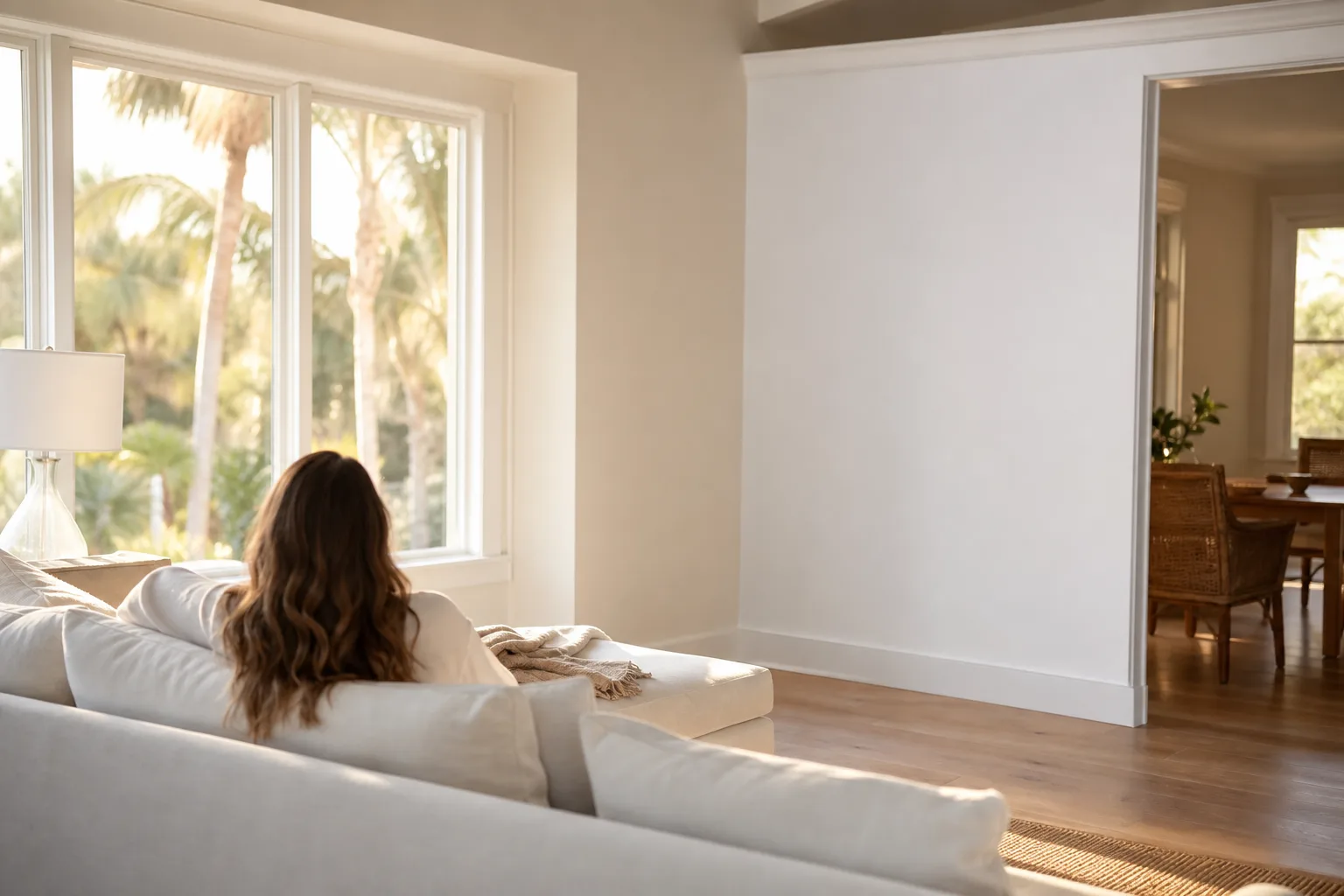
White feels like the no-risk color. It's not. Stand two whites side by side on a wall — one warm, one cool — and they look like different colors entirely: one glows soft and inviting, the other reads sharp and clean, and put the wrong one in the wrong room and your "fresh white" turns dingy, cold, or faintly yellow. The label says white. The undertone decides everything.
So which one belongs in your home: warm white or cool white? The honest answer is that it depends on your light and what's already in the room — but that's a decision you can make on purpose instead of by luck. This is a plainspoken warm white vs cool white paint comparison for walls, trim, and whole rooms, with the Gulf Coast light reality built in, so you end up with a white that looks intentional in every room it touches.
Warm white vs cool white: the short version
Answer-first: warm white leans yellow, cream, or beige and feels cozy; cool white leans blue, gray, or green and feels crisp. Everything else flows from that one difference.
| Warm white | Cool white | |
|---|---|---|
| Undertone | Yellow, cream, beige | Blue, gray, green |
| Feels | Cozy, soft, inviting | Crisp, fresh, bright |
| Best light | Warm or low light; works almost anywhere | Strong, bright, or north light |
| Pairs with | Wood, tan stone, warm metals, brass | Gray/white quartz, marble, chrome, black |
| Risk if mismatched | Can go muddy or yellow in cool/low light | Can go gray, flat, or clinical in low light |
Neither is "better." Warm white is the more forgiving, more flexible pick for most homes and most light — it's hard to make it feel cold. Cool white is the sharper, more modern look, but it needs light to stay crisp; starve it and it slides toward gray. Knowing which way each one fails is half of choosing right.
When a warm white is the right call
Reach for a warm white when you want a room to feel soft, lived-in, and welcoming. Warm whites carry just enough yellow or cream to read as white without ever feeling stark, and they hold that softness even when the light is low. That's why they're the default in living rooms, bedrooms, hallways, and any space you want to feel cozy rather than clinical.
Warm whites also play beautifully with warm materials — honey and oak wood floors, tan or cream stone, brass and bronze fixtures, beige tile. If your fixed elements run warm, a warm white ties the whole room together. A few popular warm-leaning whites worth asking for are Alabaster (SW 7008), a soft warm white that flatters almost any room, and Greek Villa (SW 7551) when you want something a touch creamier.
When does a cool white win?
Reach for a cool white when you want crisp, clean, and modern — and when you have the light to support it. Cool whites carry a faint blue, gray, or green that reads fresh and sharp, which is exactly what you want in a bright bathroom, a sun-filled modern kitchen, a laundry room, or any space where "clean" is the goal. In strong light, a cool white stays brilliant where a warm white might start to look yellow.
Cool whites also suit cool fixed elements — gray or white quartz, marble, stainless and chrome, black hardware, cool-gray tile. If your surfaces lean cool, a cool white keeps everything in the same key. Pure White (SW 7005) is a clean near-neutral that leans just slightly cool, and it's a reliable pick when you want bright-but-not-icy. Just respect the light requirement: drop a cool white into a dim, north-facing room and it can turn flat and gray fast. Cool whites earn their crispness from light — give them less and they give you less back.
How Gulf Coast light tips the scale
Here on the Gulf Coast, the light leans warm and runs strong — long, bright, often-hazy sun for most of the day, especially through south- and west-facing windows. That has a real effect on whites: warm natural light flatters warm whites and can push a cool white's blue or gray forward until it reads cold, while a bright cool white in a sun-blasted room can hold up better than it would up north.
In practice, that's why soft, warm-leaning whites are such a safe bet in a lot of Mobile and Baldwin County homes — they keep their softness in our light instead of going clinical. But it's not a rule. A bright, modern, north-facing bath with white quartz can carry a clean cool white beautifully. The point is to read your room's light before you decide. Because light moves the undertone so much, it's worth understanding on its own — our guide on how natural light changes paint color in north- vs south-facing rooms covers orientation in depth, and if you want the full mechanics of why any white leans the way it does, start with understanding paint undertones.
Walls, trim, and whole-house flow
Whites rarely live alone. The white on your trim, your ceiling, and the next room over all have to agree, or the mismatch shows up the moment two walls meet at a corner.
- Trim: lean your trim white the same direction as your walls. A crisp, cleaner white trim against a soft warm wall gives a nice, gentle contrast. A warm trim against a cool wall, on the other hand, can read yellow and tired.
- Ceilings: a slightly cooler or cleaner white overhead keeps a ceiling from looking dingy, since ceilings get less direct light and warm whites can go gray up there.
- Whole-house flow: you can absolutely mix a warm white through living spaces and a crisper white in a bright kitchen or bath — just don't put a warm white and a cool white on walls you see at the same time. Within a sightline, pick a lane.
See your white before you commit
The fastest way to settle warm vs cool is to stop imagining it and look at it. Upload a photo of your room to our free AI Color Visualizer and preview real warm and cool whites on your own walls, in your own light, against your own floors and furniture. A white that looks perfect on a chip can read completely different in place — seeing it on your walls beats guessing every time.
And if you'd rather not sort it out alone, that's what we're here for. We help Mobile and Baldwin County homeowners pick the white that fits their light every week, and we back every job with our 3-year workmanship warranty. For the bigger picture on planning a repaint, see our interior house painting guide — then call us for a free in-home estimate and we'll get the white right before the first cut line goes in.