
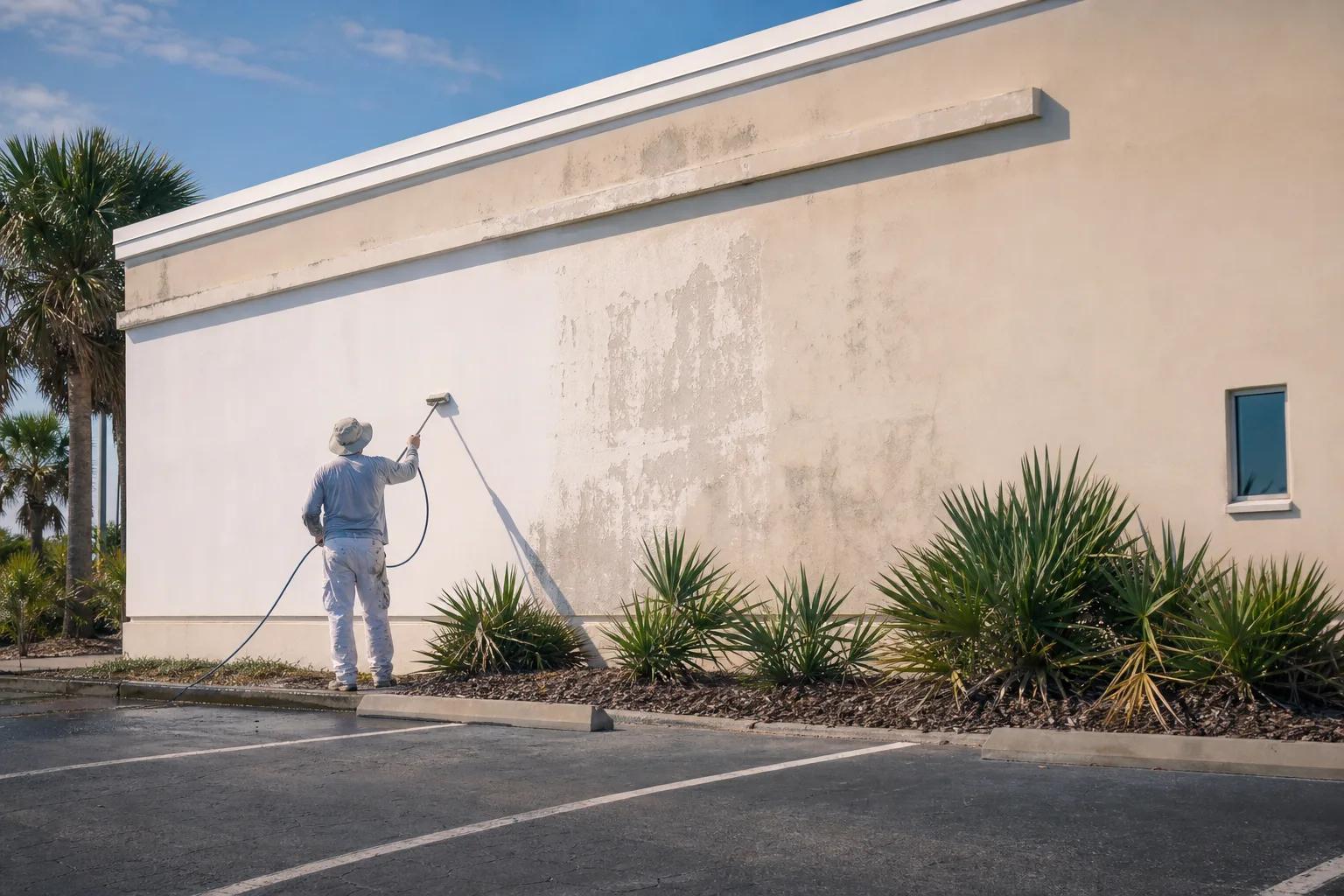
Pull into a strip center or office park around Mobile and look at the same building from two sides. The wall facing the street and the afternoon sun often looks a shade washed out and a little dusty; the shaded side still holds its color. Same paint, same crew, same day in the can — and one elevation has aged years faster than the other. That gap is the Southern sun doing its work.
For a facility or property manager, that fade isn't just cosmetic. A chalky, lightened front is the first thing a tenant or customer sees, and it's an early warning that the coating is giving out where the building takes the most punishment. Commercial paint fading on the Gulf Coast isn't bad luck or a bad batch — it's a predictable response to UV, salt, and humidity, and once you know what's driving it, you can slow it down a lot.
What actually makes the color give out
Three forces hit a Gulf Coast exterior at once, and they feed each other. UV is the big one: sunlight breaks down the binder — the resin that locks pigment to the wall — and as that binder fails, loose pigment lifts off as a powdery film. That's chalking, and it's the surface literally shedding its color.
Salt makes it worse. Mobile sits on the bay and the river, and salt-laden air carries well past the shoreline. It settles as a fine film that holds moisture against the wall and abrades the finish as wind and grit move across it. Then there's the heat and humidity, which run for months down here and speed up every reaction — a hot, damp wall ages a finish faster than a cool, dry one. Put the three together and you get a coating that's under load every single day, not just during a few harsh weeks. Our deeper look at commercial painting cost on the Gulf Coast gets into why these conditions push repaint cycles tighter here than inland.
Why do the south and west walls always lose first?
If you only remember one thing, make it this: the sun doesn't hit a building evenly, so it doesn't fade evenly. The south and west elevations catch the most direct sun across the day and straight through the brutal Gulf Coast afternoon. The north side, shaded for much of the day, can look nearly new while the sun-facing walls chalk and lighten. It's why a smart repaint plan treats elevations differently instead of assuming the whole building wears at one rate.
Color makes that split sharper. Deep reds, navies, and saturated brand colors lean on organic pigments that the sun breaks down faster, and dark tones soak up more solar energy and run hotter, which accelerates the whole process. A bold logo wall facing west is about the hardest assignment you can hand a finish on the coast. You don't have to give up your brand color — but it helps to go in knowing that wall will need attention before the soft-neutral walls around it do, and to spec a more UV-stable product for it. If you're weighing options, our color consultation walks through which tones hold up, and you can preview combinations on a building with the color visualizer.
How to slow the fade
You can't shut off the Southern sun, but you can stack the deck so your finish holds color far longer. Three levers do most of the work — the right product for what you're painting, smarter color choices on the sun-facing walls, and keeping salt off the surface.
Match the product to the substrate
Stucco, masonry, metal, and wood each want a different system. We spec a premium exterior built for UV and moisture — Sherwin-Williams Emerald or Duration on walls, Emerald Urethane Trim Enamel on doors and trim — instead of one generic paint for the whole building.Go lighter and UV-stable where the sun is worst
On south and west elevations, lighter tones and UV-stable formulations hold color longest. We can color-match any brand in-house, so your brand identity stays intact while the sun-blasted walls get a formula built to keep it.Wash the salt off on a schedule
Salt film traps moisture and grinds at the finish. A maintenance wash a couple of times a year — including one after storm season — keeps it from baking into the coating and does more for color retention than most owners expect.Fix small failures before they spread
Re-caulk split joints, spot-prime any bare spots, and touch up the worst elevations before water gets behind the coating and turns a fade into a repair.
That last point is where a maintenance program for your commercial property earns its keep. Catching the sun-facing walls early — washing, touching up, and recoating before they chalk all the way out — stretches the years between full repaints and keeps the building from ever looking neglected. Prep is half the battle: even the best commercial painting finish fails early if it goes on over a dirty, salt-filmed wall.
The exposure picture, side by side
The clearest way to plan a repaint is to see how each part of the building is loaded. Exposure and color, not age alone, decide what fades first.
| Surface / choice | Fade exposure | What it means for you |
|---|---|---|
| South & west elevations | Highest — full sun into the afternoon | Fade and chalk first; spec UV-stable products and inspect these soonest |
| North & shaded walls | Lowest — limited direct sun | Hold color longest; often still sound when sunny walls are due |
| Dark / bold brand colors | High — organic pigments break down faster | Beautiful but shorter-lived on sun walls; plan earlier touch-ups |
| Light / neutral colors | Lower — inorganic pigments resist UV | Best color retention; smart default for big sun-facing fields |
| Salt-exposed elevations | Elevated — film traps moisture, abrades finish | Need regular washing to keep the finish from grinding down |
You don't have to memorize this — it's the kind of read we do for you on a free estimate, elevation by elevation, before anyone quotes a repaint.
When fade means it's time to repaint
Fading is a spectrum, and not every faded wall needs paint tomorrow. Heavy chalk that powders your hand, color that's drifted well off the original, peeling or cracking at the edges, and salt-streaked elevations that won't come clean are the signals a coating has reached the end of its run. When several of those show up together — especially on the south and west walls — you're past touch-up territory. If you also care about timing the work around your operations, our guide to phasing a commercial painting project covers how to repaint a live building without shutting it down.
Bottom line
Commercial paint fades fast in the Southern sun because UV, salt, and humidity gang up on it every day — and the sun-facing walls and bold colors lose first. You can't stop the sun, but the right product, lighter and UV-stable colors where it's worst, and regular washing buy you years of color before the next full repaint.
If your building's front is starting to look tired while the rest still holds up, let's take a look. Pro 1 Painters has been family-owned since 2013, we back our work with a 1-year workmanship warranty, and we'll send a written quote within 24 hours of a free on-site estimate. Schedule a free commercial estimate and we'll grade every elevation and tell you straight what it needs.