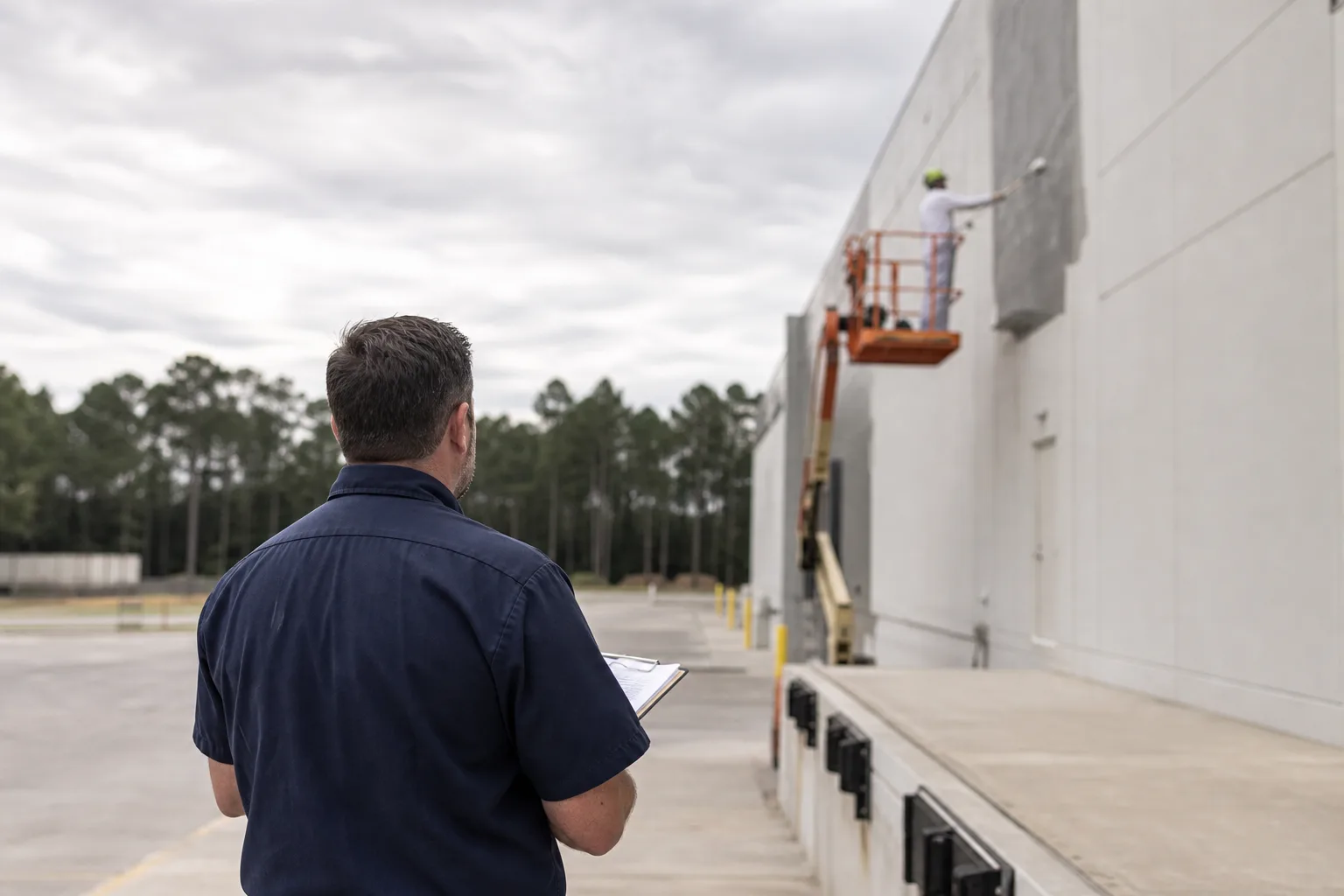
A painter's crew shows up to your facility, runs lifts along a busy storefront, and sprays two stories of exterior wall. Now picture one of two things going wrong: a worker falls, or a sprayer drifts onto a row of customer cars. Who pays? If you didn't ask for one piece of paper first, the answer might be you.
That piece of paper is a certificate of insurance — a COI — and it's the single most important document a facility manager or property owner should collect before any commercial painter starts work. It's not red tape. It's the difference between a contractor's insurance company handling a problem and your business eating the cost. Here's exactly what a certificate of insurance for a commercial painter is, what it must list, and how to read one so you're actually protected.
What is a certificate of insurance, and why it matters
A certificate of insurance is a one-page summary from an insurance carrier proving a company carries active coverage. For a commercial painter, it confirms the business is genuinely insured — usually for general liability and workers' compensation — and shows the policy types, dollar limits, policy numbers, insurer, and the dates the coverage is in force.
In plain terms: it's proof, on the carrier's letterhead, that the painter is insured right now. A contractor can say "we're fully insured" all day. The COI is what backs that claim up with something you can verify.
Why it matters comes down to risk. Painting commercial properties means ladders, lifts, solvents, and overspray around people, vehicles, and expensive finishes. When something goes wrong, the question is always whose insurance responds. A valid COI confirms the painter's carrier — not your business — stands behind covered incidents.
What a commercial painter's COI should list
A complete COI should show two coverages, plus the details that prove they're real and current. Skim for these every time. A certificate that's missing workers' comp, has stale dates, or shows thin limits isn't giving you the protection you think it is.
| What to check | What you want to see | Why it protects you |
|---|---|---|
| General liability | Active policy, commonly $1M per occurrence | Covers damage to your property or third parties from the painter's work |
| Workers' compensation | Active policy covering their employees | Covers the painter's own crew if injured on your site — not your business |
| Policy dates | Effective & expiration dates that span your whole project | Confirms coverage is actually in force during the work |
| Carrier & policy numbers | Named insurer and real policy numbers | Lets you verify the policy is genuine, not fabricated |
| Additional insured (on request) | Your business named on the certificate | Extends the painter's liability policy to cover you directly |
General liability vs. workers' comp — you want both
These cover two different risks, and a serious commercial job needs protection on both fronts:
- General liability covers damage the painter causes — overspray on cars, a ladder through a storefront window, a slip caused by their materials or process. This protects your property and any third parties.
- Workers' compensation covers the painter's own employees if they're injured on your site. Without it, an injured worker could potentially look to the property owner. With it, that exposure stays with the painter's carrier where it belongs.
A COI that shows only one of the two leaves a gap. Insist on both for any commercial painting project.
How do you verify a COI before work starts?
Collecting the certificate is step one. Actually reading it — and confirming it's real — is what closes the loop. The process takes about ten minutes and saves you from the only kind of surprise no facility manager wants.
Request the COI before scheduling
Ask for a current certificate of insurance before you sign or put the job on the calendar. A reputable commercial painter provides one without hesitation — it should be a routine request, not an awkward one.Confirm both coverages are listed
Check that the certificate shows general liability AND workers' compensation, each with policy numbers, dollar limits, and the insurer's name. One without the other leaves you exposed.Verify the dates are current
Make sure the effective and expiration dates cover your entire project window. An expired policy — or one set to lapse mid-job — doesn't protect you when it counts.Ask to be named additional insured
For larger commercial jobs, request that your business be listed as an additional insured. That extends the painter's liability policy to cover you directly, rather than chasing a claim from the outside.Have it sent from the agent
For full assurance on a sizable contract, ask the painter's insurance agent to send the certificate directly to you. That confirms it's genuine and unaltered — not a doctored copy.
A certificate of insurance is one item on a larger vetting checklist, but it's the one you should never skip. Pair it with checking references, reading exactly what the written scope covers, and confirming the company's track record — our checklist for vetting a commercial painting contractor walks through the rest. For the full picture on hiring the right contractor for your building, read our commercial painting guide for Mobile and Baldwin County.
The bottom line for facility managers
A certificate of insurance is your proof that a commercial painter carries the general liability and workers' compensation coverage that keeps risk off your business. Require it before work starts, confirm both coverages are active and current, ask to be named as an additional insured on larger jobs, and verify the document is genuine. It's ten minutes of due diligence that protects a building — and a budget.
Pro 1 Painters has been a family-owned company serving Mobile and Baldwin County since 2013. We put the full scope of your project in a written quote within 24 hours of a free estimate, run one accountable crew with a manager who signs off before final payment, and back every job with a 1-year workmanship warranty. When you're ready, learn more about our commercial painting services and request a free, no-obligation estimate for your facility.