
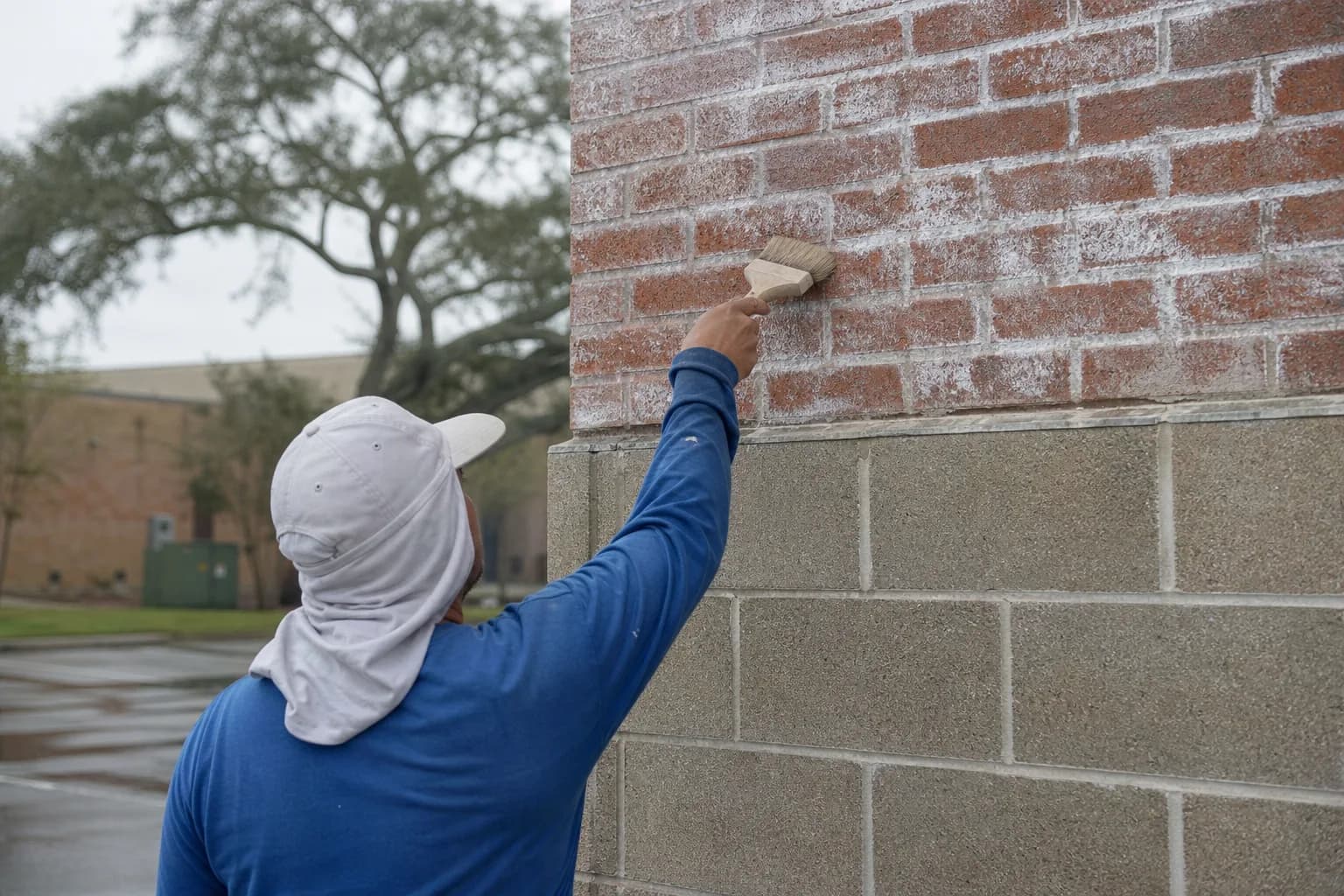
You've seen it: a chalky white haze creeping across a brick or block wall, sometimes a powder you can wipe with a finger, sometimes a hard crust. It's called efflorescence, and on the Gulf Coast it shows up on masonry all the time. The mistake we get called to fix most is someone painting right over it — because within a season the paint is peeling off in sheets, taking the white bloom with it. Efflorescence isn't a cosmetic stain you can cover. It's a message from the wall about moisture, and you have to read it before a brush touches the masonry.
What efflorescence actually is
Efflorescence is mineral salt left on the surface of masonry — brick, concrete block, stucco, mortar — when water moves through the wall and evaporates. The water dissolves soluble salts inside the masonry, carries them to the surface, and then evaporates into the air, leaving the salt behind as a white powder or crust. So the white you're seeing isn't dirt or mold. It's salt, and it's loose, sitting on top of the wall rather than bonded into it.
That last part is why you can't paint over it. Loose salt makes a terrible surface for paint to grip. A coating applied over efflorescence bonds to the salt, not the masonry — and the moment the salt lets go, your paint comes with it.
Why does Gulf Coast masonry get efflorescence so often?
Efflorescence needs two things: salts in the masonry and water moving through it. The Gulf Coast supplies plenty of the second. Humidity stays high, wind-driven rain pushes water into walls, ground stays damp, and drainage around older commercial buildings is often poor. All of that drives moisture into brick and block, and as it evaporates at the surface, the salt blooms.
It's most common on below-grade and ground-level walls where moisture wicks up from the soil, around windows and parapets where flashing has failed, and on freshly built or repointed masonry that's still releasing construction moisture. Anywhere water has a steady path through the wall, expect the white to follow.
Efflorescence vs. the other things on a masonry wall
It's worth knowing what you're actually looking at, because the fixes are different. Painting a wall before you've correctly identified the problem is how the job fails.
| What you see | What it is | What it needs |
|---|---|---|
| White powder or crust, gritty | Efflorescence — mineral salt | Remove salt, stop the moisture, seal, then paint |
| Gray/green/black, fuzzy or slimy | Mold or mildew | Clean, kill growth, mildew-resistant finish |
| Chalky residue on old paint | Chalking — degraded paint binder | Dechalk and prime before recoating |
| Hairline cracking on stucco | Movement or shrinkage cracks | Crack repair, then a flexible coating |
If the deposit is gritty white salt, it's efflorescence. If it's darker and fuzzy, you're likely looking at mildew, which is a different fight — we cover that in anti-mildew and mold-resistant paint for Gulf Coast homes. And if your trouble is cracking stucco rather than a salt bloom, that's stucco crack repair before painting, not an efflorescence job.
How to remove efflorescence and paint over it correctly
There's a right order to this, and skipping a step is what brings the bloom back. The sequence is always: find the water, remove the salt dry, let the wall dry, seal, then paint with a breathable system.
Find and address the moisture source
Efflorescence is a symptom, so the first job is the water. Look for leaks, failed flashing, bad grading, gutters dumping at the wall, or ground moisture wicking up, and correct what's feeding the wall. Clean without fixing this and the salt simply returns under your paint.Remove the salt — dry first
Brush off light efflorescence dry with a stiff masonry brush, because wetting it can drive the salt back into the wall. Heavier crusts get a masonry cleaner or a diluted efflorescence wash, scrubbed, then rinsed and dried completely. The goal is a salt-free surface.Let the masonry dry out fully
Once the moisture source is fixed and the salt is gone, the wall needs to dry. Painting damp masonry on the coast traps moisture and invites the next bloom plus peeling. Drying time depends on the wall and the weather — patience here protects the whole job.Seal, then paint with a breathable masonry system
Prime or seal the masonry as the surface calls for, then topcoat with a quality breathable masonry paint that lets the wall release vapor instead of trapping it. A breathable system is what keeps any future moisture from blowing the coating back off.
That breathability matters on masonry more than people expect. A wall still releases small amounts of vapor, and a coating that seals it up tight can blister when moisture pushes back. The fix isn't a heavier, tighter film — it's stopping the water, clearing the salt, and using a system built to breathe.
A word on new and freshly repointed masonry
New construction and recently repointed walls bloom with efflorescence almost as a rule, because fresh mortar and block carry their own moisture and salts that have to work their way out. That's not a defect — it's the wall curing. The mistake is painting it too soon. New masonry needs time to release that initial moisture, and we'd rather let a wall cure and clear its first bloom than seal construction moisture and salt under a coating that'll fail. When a building's on a schedule, we factor that drying window into the plan instead of pretending it isn't there.
Why "just pressure-wash and paint" backfires
The instinct with a white wall is to blast it clean and roll paint the same week. On efflorescence, that's two mistakes at once. Heavy wetting can drive salt back into the masonry rather than removing it, and a wall that's still wet from washing has no business taking a coating in Gulf-Coast humidity. Removing salt dry where possible, then drying the wall fully, is slower — but it's the difference between a finish that holds and one that's peeling by the next wet season.
Where efflorescence shows up on commercial walls
On commercial buildings, efflorescence loves concrete block and brick at ground level, parapet walls, and anywhere flashing or drainage has gone wrong. The treatment is the same idea as a home, but the moisture sources are often bigger — a long run of failed flashing, a grading problem along a whole elevation, water getting behind a parapet cap. Block walls in particular are porous and salt-prone, which is why we go deep on prepping them in cinder block and CMU painting on the Gulf Coast.
It comes up on homes too — foundation walls, brick veneer, stucco near grade. Wherever it is, it lands in the same place: a masonry surface that won't hold paint until the salt's gone and the water's handled. For the full commercial picture, our commercial painting guide for Mobile and Baldwin County walks through how masonry fits the rest of a coating plan.
Don't paint over the bloom — get a real read first
Efflorescence is fixable, and a properly cleaned, dried, and sealed masonry wall takes paint beautifully and holds it. But every step matters, and the one people skip — finding the moisture causing it — is the one that decides whether the white comes back. That's a judgment best made at the wall, in Gulf-Coast humidity, where trapped moisture shows up fast.
If you've got a white bloom on brick, block, or stucco, that wall is telling you water's moving through it. Book a free estimate and we'll diagnose what's feeding it, lay out how we'll remove the salt and seal the surface, and put the plan in a written quote within 24 hours. You can see the rest of what we handle on our commercial painting and exterior painting pages.