
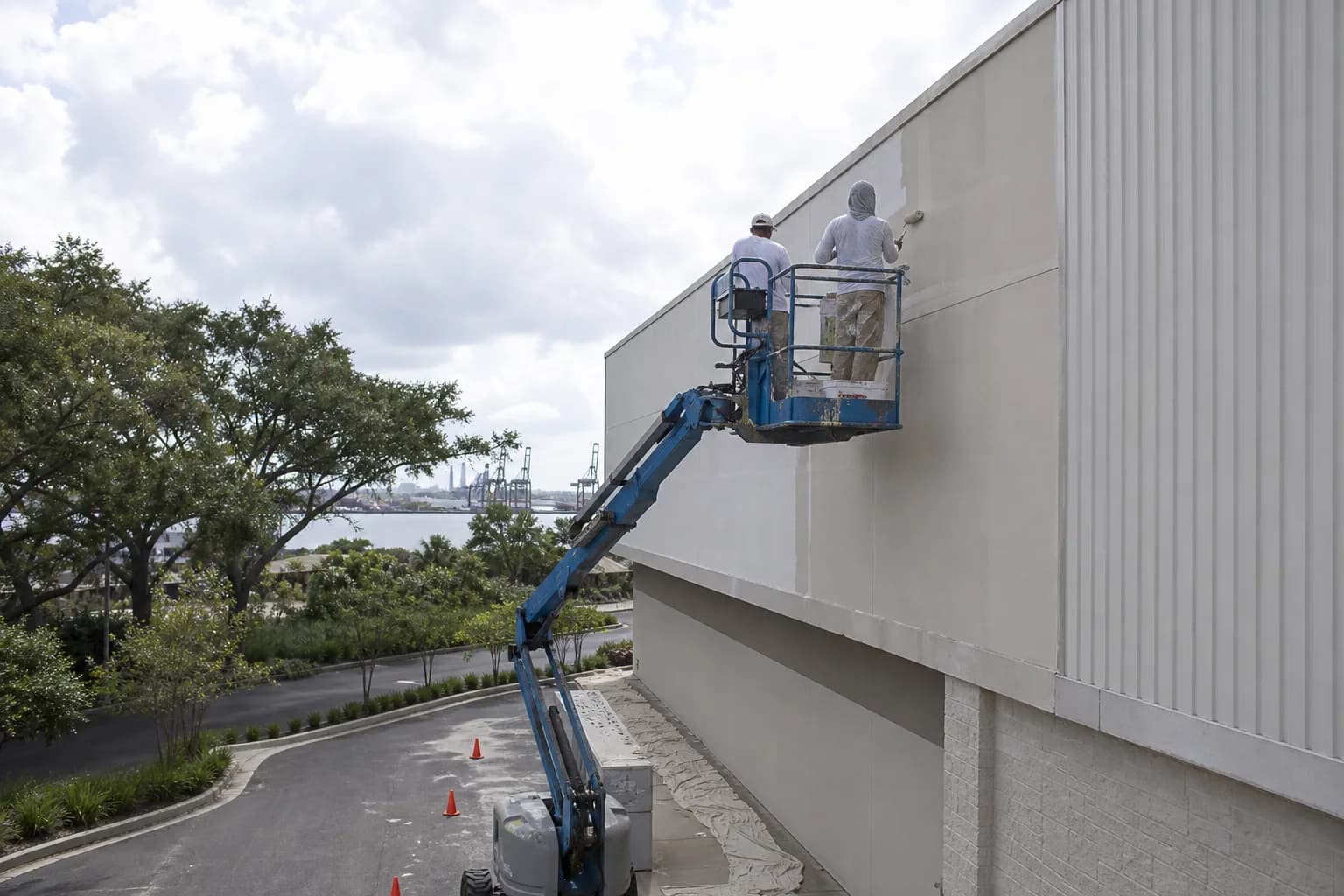
A commercial building on the Gulf Coast is a bigger target than a house. More wall, more surfaces, more exposure — and the same relentless trio of salt, humidity, and sun working on all of it at once. When a coating fails on a storefront, an office, or a warehouse, it's not a weekend touch-up; it's lifts, downtime, and real money. So the goal for a commercial exterior here isn't just fresh paint. It's a coating system built to outlast the coast.
This guide is about that system. We'll cover how salt air and UV actually attack a commercial envelope, why the right coating depends on the surface — not a single magic product — and how a job gets done without shutting your business down. Elastomeric is part of the conversation, but it's one tool among several, not the whole answer.
What salt air and UV do to a commercial envelope
Before you choose coatings, you have to know the forces wearing them down. A Gulf Coast commercial exterior gets hit on three fronts at once, and a durable system has to answer all three.
- Salt-laden air. Salt rides the breeze well past the immediate shoreline and settles on the building as a fine film. That film holds moisture against the surface and keeps fresh coating from bonding — and on metal, it drives rust underneath the paint.
- Around-the-clock humidity. Warm, damp air feeds mildew that shows as black or green speckling on shaded elevations, and keeps surfaces from drying between rains.
- Hard, sustained sun. UV pounds the sunny faces, breaking down the binder that holds a coating together. That's the chalking and fading you see first on south- and west-facing walls.
Matching the coating system to the surface
Answer-first: there is no single best commercial coating — there's a best system for each surface on your building, all of them premium and salt- and UV-rated. Here's how the major commercial surfaces on the coast line up with the coatings that hold longest.
| Surface | How it fails on the coast | Coating approach that lasts |
|---|---|---|
| Stucco / masonry | Hairline cracking, salt in the pores | Premium acrylic; elastomeric on sound, dry, crack-prone or wind-exposed walls |
| Metal (siding, doors, rails) | Rust under the film from salt and edges | Rust-inhibiting primer + a coating made for metal |
| Wood trim & fascia | Soft wood, peeling from moisture movement | Repair first, then a flexible exterior acrylic |
| Fiber cement | Failure at unsealed cut edges | Sealed edges + a quality acrylic to spec |
| Previously coated walls | Chalking, loss of adhesion | Wash, de-chalk, spot-prime, then recoat |
Notice that elastomeric shows up in exactly one row, and even there with conditions. It's a strong tool on sound, dry, exposed masonry that cracks or takes wind-driven rain — but it's wrong on wood, wrong on metal, and wrong on a damp wall, because its thick film traps moisture where the surface needs to breathe. If you want the full decision on that one product, our guide on when to use elastomeric coating and when not to lays it out, and the elastomeric vs acrylic comparison for Gulf Coast stucco covers the masonry trade-off head to head. The point for a commercial owner is simpler: don't coat a mixed-surface building in one product. Match each surface, and the whole envelope lasts.
Why prep decides a commercial job more than the can
Here's the part that doesn't make the brochure: on the coast, most commercial coating failures are prep failures, not product failures. A premium system still peels fast over a salt film, chalk, mildew, rust, or soft wood — and on a building-sized envelope, redoing that is genuinely expensive.
A commercial-grade prep sequence does the unglamorous work that earns the years:
- Wash off the salt and mildew. Pressure-washing removes the salt film, mildew, chalk, and pollen that keep coatings from bonding — the most common reason a coastal exterior fails early.
- Treat rust and bare metal. Metal surfaces get rust addressed and a rust-inhibiting primer, because a topcoat over active rust is just buying time.
- Repair the soft wood. Humidity finds fascia, trim, and soffits. Soft boards get repaired or replaced first; no coating sticks to punky wood.
- Prime and seal where needed. Bare masonry, repaired wood, and cut fiber-cement edges get the right primer or sealer so the finish coat locks onto a uniform, sound base.
Can you paint a commercial building without shutting it down?
Durability is half the job. The other half is getting it done without costing you business. A storefront can't lose its entrance for a week, and a warehouse can't stop shipping while the walls get coated. So the schedule matters as much as the coating.
We plan commercial exterior work around how your building actually runs:
- Sequence the elevations. We work the building in sections so entrances, dock doors, and parking stay usable, moving around your traffic instead of through it.
- Use off-hours where it helps. Evening and weekend windows let us handle high-traffic faces and entries with the least disruption. (For the cases where that's the whole plan, see our take on after-hours and weekend commercial painting on the Gulf Coast.)
- Keep the site safe and clean. Lifts, drop cloths, and cones are managed so customers and staff stay safe and the property stays presentable while the work is underway.
- Map it before we start. You get the sequence and the timeline up front, so there are no surprises mid-project.
Timing the season helps too. Spring and fall give moderate temperatures and lower humidity than peak summer, which lets coatings cure the way they're supposed to — and on a coating system that depends on a proper cure to deliver its salt and UV resistance, that window is worth planning around. For how long a coastal building tends to go between repaints, our guide on how often to repaint a commercial building on the Gulf Coast walks through the real intervals.
How we approach your building
Every commercial envelope is its own puzzle of surfaces, exposures, and operating constraints, so we don't quote a one-size system off a catalog. We read the building — which walls take the sun and the wind-driven rain, where the metal is rusting, where the wood has gone soft, how porous the masonry is — and we match a premium, salt- and UV-rated coating to each surface. Then we build a schedule around your hours. You can see the scope of what we handle on our commercial painting page, and the broader playbook in our commercial painting guide for Mobile and Baldwin County.
The bottom line on commercial exterior coatings
Salt air, humidity, and UV wear a Gulf Coast commercial building harder than an inland one — and the buildings here are too big to repaint on the wrong schedule with the wrong product. The durable answer is a coating system, not a single can: a premium, salt- and UV-rated finish matched to each surface, applied over real prep, on a schedule that keeps your business open. Elastomeric earns a place on the right masonry, but it's one tool in a system, not the system itself. And on every surface, the prep is what decides whether the finish lasts.
We're a family-owned crew that has coated Gulf Coast buildings since 2013, and every commercial job carries our 1-year workmanship warranty with a manager sign-off before it's called done. Reach out for a free on-site estimate and we'll send a written quote within 24 hours — you can pay by Cash, Check, or Credit Card.