
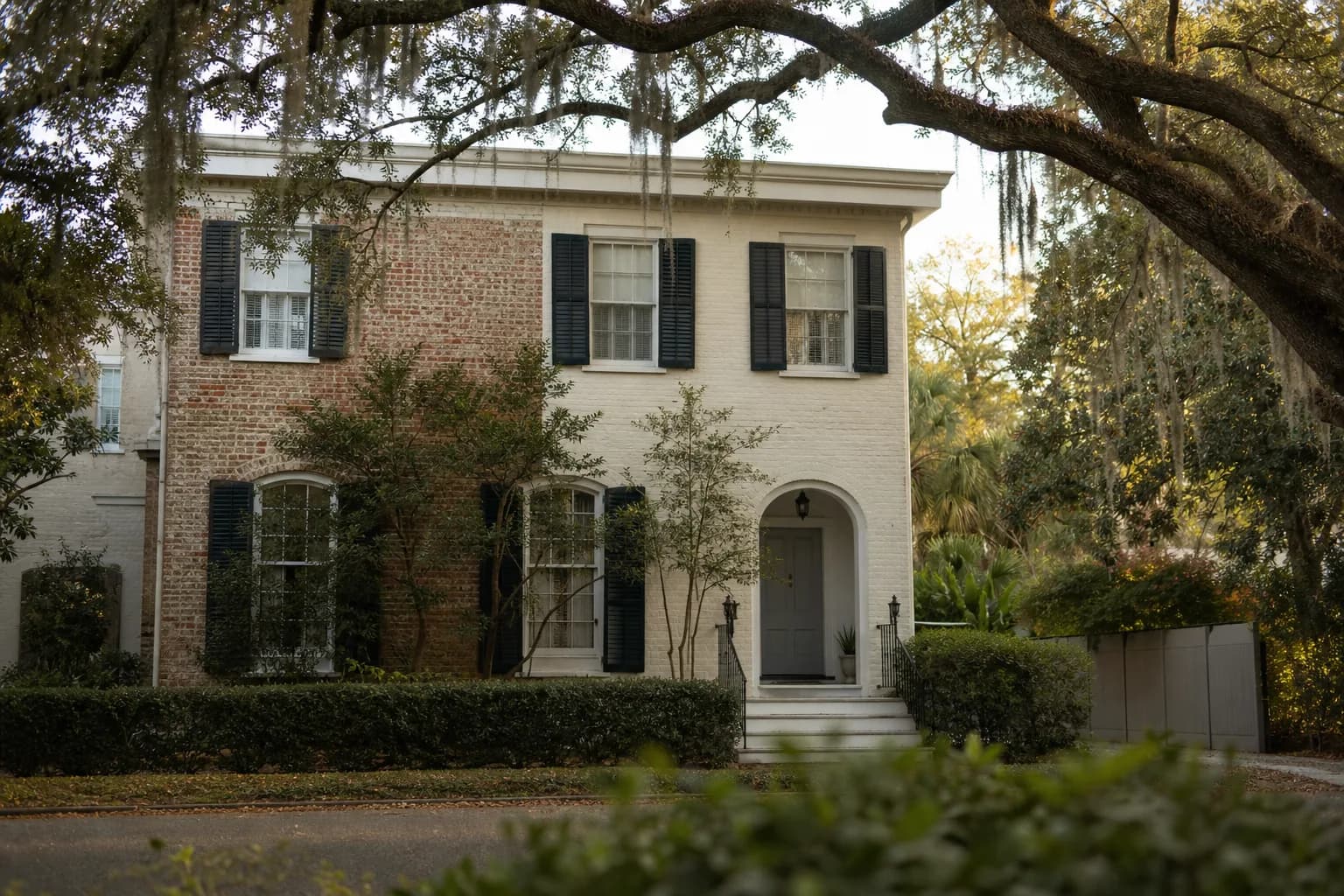
There's a moment every owner of an old Mobile brick home faces. You're standing at the curb, the brick looks tired or dated or just not you, and a painted facade in a soft white or moody charcoal is calling your name. Before you answer it, know this: painting brick is one of the few exterior decisions you genuinely can't take back. So the real question isn't "what color?" It's whether to paint that historic brick at all, or leave it natural.
This is a decision worth slowing down for. Here's how to weigh painting a historic brick home against leaving the brick natural — reversibility, your district's character, curb appeal, and the condition of the brick itself — so you make the call you'll still be happy with in ten years.
The one fact that should anchor the whole decision
Answer first: painted brick is permanent, and that single fact should sit at the center of this choice. You can paint natural brick any time you like. Going the other direction — stripping paint back off to a clean, natural face — is expensive, hard on the brick, and rarely gives you back what you started with. Sandblasting or harsh chemical stripping can scar the soft outer face of old brick, and the result usually looks worse than either honest option.
So the decision isn't symmetrical. Leaving brick natural keeps every door open. Painting it closes most of them. That doesn't make painting wrong — plenty of Mobile homes look fantastic painted — but it means the burden of proof sits on the paint side. If you're genuinely torn, the reversible-leaning choice is to wait, because the option to paint will still be there next year.
When is leaving the brick natural the stronger call?
There's a real case for doing nothing to the color, and on a lot of Mobile's older homes it's the right one. Natural brick that's original to the house carries character that paint covers over for good — the variation in tone, the texture, the way hundred-year-old masonry catches the late Gulf light. In neighborhoods where original brick is part of the architectural story, that patina is an asset, not a problem.
Leaving brick natural also sidesteps the maintenance cycle that painted brick signs you up for. And in some of Mobile's historic districts — Oakleigh Garden, De Tonti Square, Old Dauphin Way, Leinkauf — unpainted original masonry is exactly what gives the streetscape its consistency. Before you change that, it's worth knowing how your block reads — our guide to painting historic homes in Mobile's National Register districts covers the neighborhood-by-neighborhood character in depth.
Natural doesn't have to mean "leave it filthy," either. Often the brick just needs a gentle, appropriate cleaning to look its best — the warmth was there all along under the grime and mildew our climate grows.
When painting historic brick is the right move
Painting earns its place in a few clear situations, and the biggest one removes the reversibility argument entirely: brick that's already painted. If a previous owner painted it, or past repairs left you with patchy, mismatched brick and clashing mortar, the natural look is already gone. At that point a quality, breathable masonry paint that unifies the whole facade is usually the smart, practical choice.
Painting also makes sense when you want a specific, uniform result that natural brick simply can't deliver — a crisp documented white, a soft historic green, a deep charcoal that ties the trim and brick together. And it can genuinely modernize a dated facade. The key is doing it right for our climate, which means a breathable masonry product over sound, properly prepped brick so you don't trap moisture in the wall. We cover the how in our guide on painting brick without trapping moisture, and the broader trade-offs in painting a brick house on the coast: pros and cons.
The Mobile factors that tilt the decision
A few realities specific to Mobile deserve a seat at the table, because they change both the risk and the upkeep math.
The climate is hard on any coating. Mobile averages about 52 inches of rain a year, and the heavy Gulf humidity keeps masonry damp far longer than it would dry inland. That matters two ways. Natural brick needs to breathe to shed all that moisture, and if you do paint, it has to be a breathable masonry system over healthy brick — sealing damp brick under the wrong coating is how you get bubbling, peeling, and spalling down the line.
Many of these homes are genuinely old. The median Mobile home was built around 1973, and entire historic blocks date to the 1800s. Older brick and original mortar are softer and more sensitive than modern masonry, which raises both the stakes of a permanent change and the importance of gentle, correct prep.
Water-managed details matter near the bay. Much of low-lying Mobile sits in a FEMA AE flood zone, and homes close to Mobile Bay that take on water at the base need their masonry to dry out, not stay sealed. That's one more reason breathability — natural or painted — isn't optional here.
| Consideration | Leave brick natural | Paint the brick |
|---|---|---|
| Reversibility | Fully reversible — you can paint later anytime | Essentially permanent — very hard to undo |
| Best when | Brick is original, sound, and part of the home's character | Brick is already painted, patchy, or you want a uniform color |
| Upkeep | Occasional gentle cleaning; no repaint cycle | Repaint every several years; must stay breathable |
| District fit | Often preferred where original masonry defines the street | Can clear review with a period-appropriate color |
| Curb-appeal effect | Timeless, historic warmth and texture | Crisp, updated, fully uniform look |
Check the rules before you fall for a color
One more step belongs before any decision is final. Some of Mobile's historic neighborhoods are locally designated, and exterior changes — including painting masonry — can fall under architectural review by the city. The rules differ by district and by what you're changing, so a quick check with the City of Mobile tells you what applies to your address before you get attached to a particular look. We're painters, not the city, but we'll happily build the project around whatever your district requires.
If review does apply, a period-appropriate approach tends to move more smoothly than a bold off-trend color. And whichever direction you lean, see it before you commit — color reads completely differently on a full brick facade in Mobile's bright light than on a sample. Snap a photo of your home and preview real finishes on it with our free AI Color Visualizer.
Make the call once, and make it right
The honest summary: if your historic brick is original, sound, and part of what makes the house special, leaning toward natural keeps your options open and honors the home. If the brick is already painted, mismatched, or you want a uniform look you can't get any other way, a breathable paint done right for our climate is a solid choice. Either way, the worst outcome is rushing a permanent decision over dirty brick that just needed a wash.
Pro 1 Painters has been a family-owned crew working on older homes across Mobile since 2013, based minutes from the historic core. We'll look at your actual brick, tell you straight whether it's a paint candidate, and lay out your options without pushing the permanent one. For the full picture on protecting a coastal exterior, see our Mobile and Baldwin County exterior house painting guide, then take a look at our exterior painting work and call us for a free in-home estimate with a written quote within 24 hours. Backed by our 3-year workmanship warranty and a 4.8-star Google rating. Pay by Cash, Check, or Credit Card.