
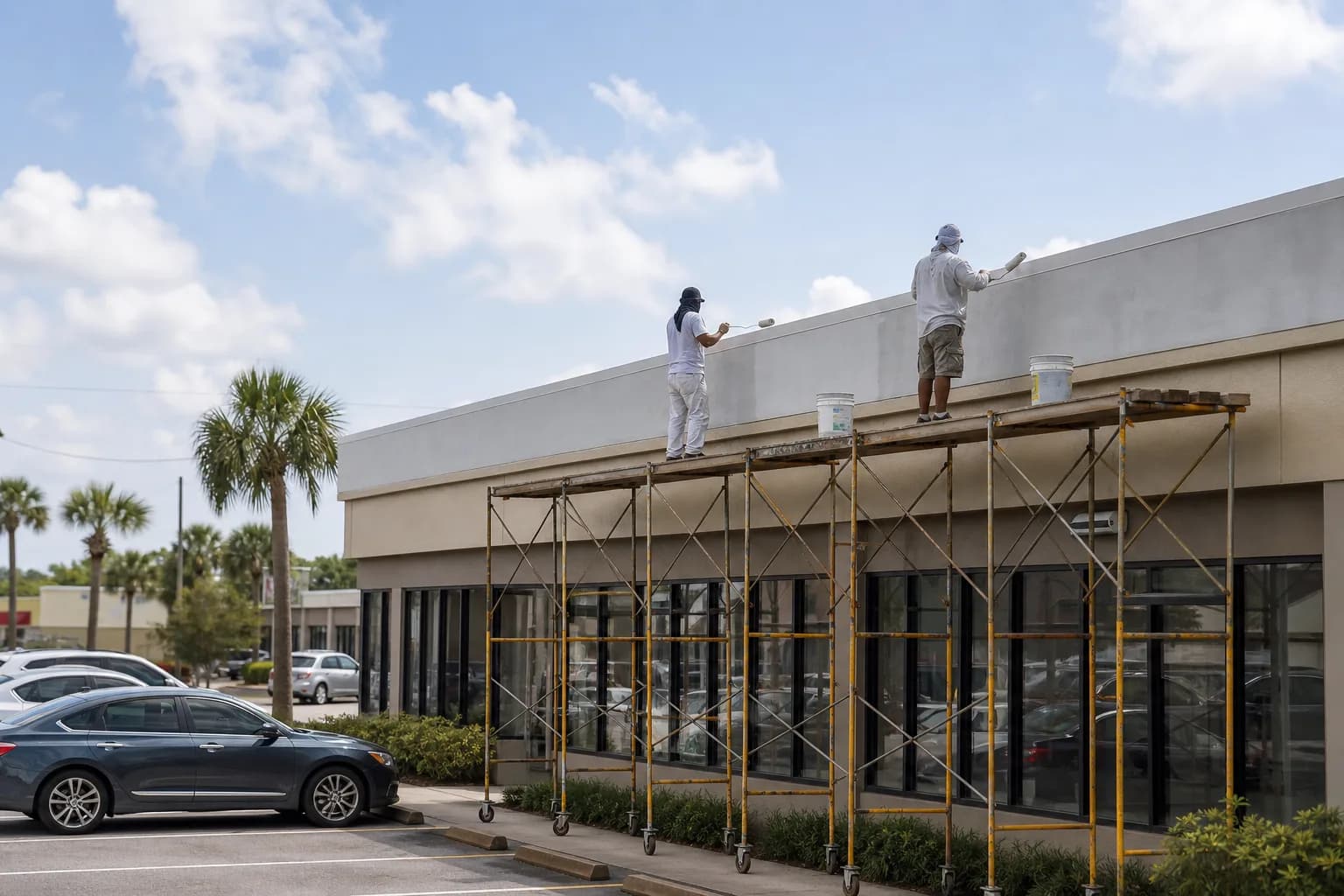
Pull into any tired strip center and your eye finds the damage before you find the store you came for: a chalky, sun-bleached parapet, rust streaks bleeding down from the roofline, a faded sign band that's three shades lighter than it left the factory, and one bay that somebody repainted a slightly different white. The whole center reads as neglected — and that impression lands on every tenant inside it. Shopping center painting on the Gulf Coast is how a property owner resets that first impression, and the good news is it can happen storefront by storefront without a single business closing its doors.
This is exterior commercial work with a multi-tenant twist. You're not painting one building for one owner — you're painting a shared facade that a dozen brands sit behind, in a climate that's hard on every coat. Here's how a retail plaza repaint actually comes together.
What shopping center & strip mall painting covers
Answer first: a strip mall repaint is mostly the shared building envelope — the parapet and fascia, the storefront columns and bulkheads, the canopy or awning structure, the signage band, the rear service elevation, and any exposed metal — plus the parking-lot-facing details that drive curb appeal. Individual tenant interiors and the signs themselves are usually separate.
The facade is what sells the center. It's the backdrop every sign hangs on and the first thing a shopper judges from the road. That's why the parking-lot-facing elevation gets the most attention: it's doing the marketing for the entire plaza.
| Facade element | What it needs | Why it matters on a retail center |
|---|---|---|
| Parapet & fascia band | Pressure wash, prime bare spots, fade-resistant field color | The biggest visible surface from the parking lot — sets the whole tone |
| Signage band / sign backers | Clean, uniform base color behind the tenant signs | A consistent backdrop makes every sign read sharper and more legible |
| Storefront columns & bulkheads | Durable, scrubbable finish at hand and cart height | High-touch zones at every entrance — scuffs show fastest here |
| Canopy / awning structure | Cleaning and a finish matched to the substrate | Frames the walkway; rust or peeling here reads as deferred upkeep |
| Rear service elevation | Practical uniform coat, rust treatment on metal | Faces loading and back doors — cheap to keep tidy, costly to ignore |
| Exposed metal (downspouts, rails, doors) | Degrease and a corrosion-resistant enamel | Salt air rusts metal trim fast and streaks it down the facade |
Not every center needs all of it at once. Sometimes it's a full facade reset before a re-leasing push; sometimes it's just the parking-lot side and the sign band ahead of a new anchor tenant. We scope each plaza on its own and put it in one written quote, because a six-bay neighborhood strip and a twenty-unit power center are different animals. For the full picture on commercial work in the area, start with our commercial painting guide for Mobile and Baldwin County.
Unify the facade, let the brands show
The single biggest lever in a multi-tenant repaint is unity. A center that's been touched up bay by bay over the years turns into a quilt of mismatched whites and beiges, and that patchwork is exactly what reads as run-down. Bring the entire base building to one palette — one field color across every parapet, one fascia, one trim, one consistent sign backer — and the plaza instantly looks like a single, cared-for property.
That doesn't erase the tenants. Their brand still comes through their own signage, awnings, and window graphics. In fact a calm, unified base makes every storefront sharper, because the signs stop fighting the wall behind them. Think of the building as a clean frame and each tenant as the picture.
Where a center has multiple buildings or pads, painting them all to one standard keeps the whole property consistent and your future touch-ups simple — one spec, one set of colors on file, no guessing the match three years from now.
Why is the Gulf Coast so hard on a retail facade?
Answer first: sun and salt are what age a coastal storefront, and they don't hit every wall evenly. Intense UV chalks and fades the field color, humidity and salt-laden air work on exposed metal and any unsealed substrate, and the south- and west-facing elevations — usually the parking-lot side — burn out first.
That uneven wear is worth planning around. The parking-lot-facing wall and any sun-blasted elevation might need attention a year or two before the shaded rear does. A smart repaint cycle leads with those, so the side every customer sees stays sharp while you stretch the budget on the elevations nobody's judging from the road.
Prep is what makes the color survive it. A real facade repaint means pressure washing off the chalk and grime, scraping any peeling to a sound edge, treating rust on metal trim, caulking the gaps that have opened around storefronts and control joints, and priming bare stucco, EIFS, or block before a drop of finish goes on. Skip that on the coast and a premium coating still chalks and lifts early — the same prep-first reality we cover in exterior commercial painting and salt-air coatings. For more on the substrate side, our exterior painting service page breaks down how we handle stucco, masonry, and metal.
Paint it without closing a single store
Answer first: you keep a shopping center open by working the exterior in zones and running the disruptive parts before the plaza opens. Tenants need their entrances clear and their hours protected, so the whole job is built around that.
A retail center can't go dark for a paint job — every closed day is a tenant's lost sales and a call to the property manager. So we sequence the facade one storefront stretch at a time, keep entrances and walkways open, and schedule pressure washing and parapet spraying for early mornings or off-hours before customers arrive. Equipment moves down the row ahead of opening; by the time shoppers show up, that section's just freshly painted. It's the same occupied-business discipline we detail in painting an occupied commercial space without closing.
One accountable crew runs the property from the free estimate to the final inspection, a manager signs off before final payment, and the work is backed by our 1-year workmanship warranty and a 4.8-star Google rating. Pro 1 Painters is family-owned, in business since 2013, with offices in Mobile and Spanish Fort serving shopping centers across the Gulf Coast.
Reset your center's first impression
Shopping center painting on the Gulf Coast is the highest-leverage exterior dollar a retail landlord spends: unify the facade to one palette, lead with the sun-and-salt-facing elevations that fade first, prep hard so the color lasts, and phase it so no store ever closes. Do that and the whole property reads as cared-for — which leases bays faster and keeps the tenants you have happy.
Got a plaza that's looking tired from the parking lot? Book a free on-site estimate and we'll walk the property, spec a unified scheme, and send one written quote for the whole exterior within 24 hours. You pay by Cash, Check, or Credit Card.