
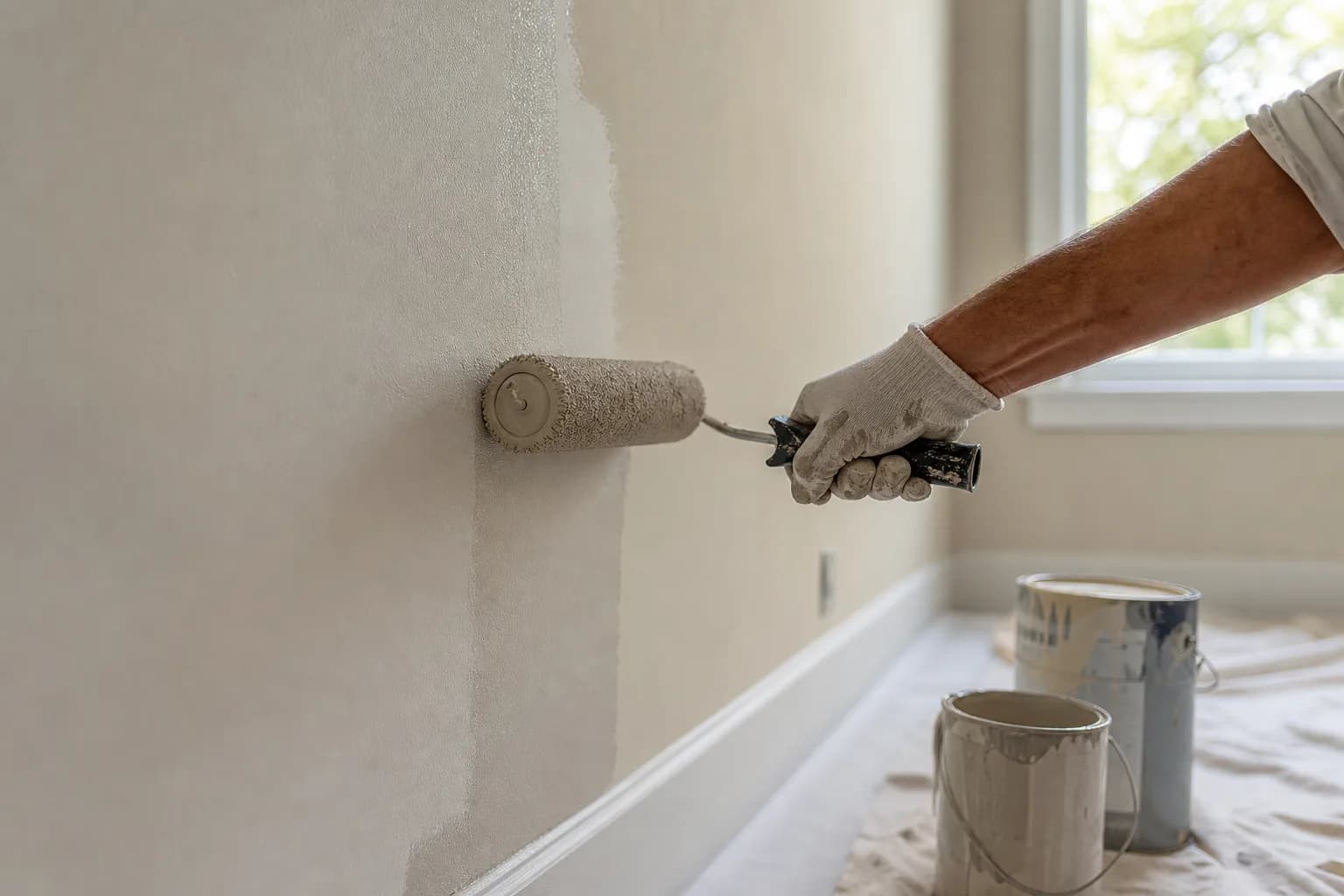
Walk the paint aisle and half the cans promise to be paint and primer at once. It sounds like a free upgrade — one product, one fewer step, same result. So homeowners grab it, skip the primer, and roll straight onto bare wood or over a water stain — and then wonder why the stain ghosts back through or the new color won't cover. The product isn't a scam. It's just widely misunderstood.
So let's clear it up: what paint-and-primer-in-one actually is, where it genuinely works, and where skipping a real primer is the move that quietly wrecks an otherwise good paint job. The short version is that it's a great tool on the right surface and the wrong tool on the surfaces people most want to use it on.
What paint-and-primer-in-one really is
Answer first: paint-and-primer-in-one is a higher-quality, higher-solids paint built to do two jobs at once — bond reasonably well and lay down enough film that, on the right surface, you can skip a separate priming coat. It is not a can of true primer mixed with a can of true topcoat.
That distinction is the whole story. A real primer is a specialist. Its job is to grip difficult surfaces, seal porous ones, block stains from coming through, and create a uniform base so your finish goes on even and true. A self-priming paint borrows some of that ability through its richer formula and thicker build, which is enough when the surface underneath is already sound. But it can't match a dedicated primer at the hard, specialized jobs — and on the Gulf Coast, the hard jobs are common.
Think of it this way: over an existing, healthy coat of paint, your "primer" need is mostly just good adhesion and coverage, and a quality all-in-one delivers that. The trouble starts the moment the surface is asking for real primer work.
When paint-and-primer-in-one actually works
It works — genuinely well — when the surface is already in good shape. The clearest green light is a previously painted, sound, clean wall where you're refreshing within the same general color family.
In that situation you're not asking the product to perform a rescue. You're asking it to bond to a stable base and cover, and a good self-priming paint does both in two coats. Picture a living room repaint: the walls are intact, no stains, you're going from one soft neutral to another. That's the ideal case — no separate primer needed, and you save a step honestly.
Good candidates for paint-and-primer-in-one:
- A sound, clean, previously painted interior wall, refreshing a similar color.
- Minor color shifts where the old and new shades aren't far apart.
- Walls with no stains, no bare spots, and no glossy finish to fight.
In those cases, reaching for a separate primer first is often overkill. The product was made for exactly this work, and the quality of the paint matters more than the label on the front — which is a big part of why more expensive paint can actually last longer: a richer formula is what lets a paint prime itself at all.
When you still need a dedicated primer
Here's where skipping the primer goes wrong — and where most DIY disappointments trace back to. A separate primer is doing specialized work the all-in-one simply isn't formulated for, and no amount of premium paint fully substitutes for it.
Reach for a real primer when:
- The surface is bare — raw wood, new or repaired drywall, fresh patch or joint compound. Bare materials drink up paint unevenly and need sealing first.
- There are stains — water rings, smoke, marker, or tannin bleed from woods like cedar. A stain-blocking primer is the only reliable way to stop them ghosting through your finish, which is exactly why we cover the best primer for stains, smoke, and water marks separately.
- You're painting over a glossy or slick surface — trim, cabinets, a previous high-gloss. Primer gives the new coat something to grip.
- You're making a dramatic color change — light over dark especially. A tinted primer evens the base so the finish covers in fewer coats.
- There's any peeling or adhesion problem. Paint over a failing surface and you've just bought yourself a redo.
| Your surface | Paint-and-primer-in-one | Dedicated primer first |
|---|---|---|
| Sound, clean, previously painted wall | Works well — fair shortcut | Optional / overkill |
| Bare wood or new/repaired drywall | Not enough on its own | Yes — seal it first |
| Water, smoke, or tannin stains | Stains will ghost through | Yes — stain-blocking primer |
| Glossy or slick surface | Risky adhesion | Yes — for grip |
| Big color change (light over dark) | Possible but many coats | Yes — tinted primer |
| Peeling or failing paint | Will fail again | Fix and prime first |
For a deeper walk through the judgment call on bare and patched walls, see when walls need primer before painting.
Does it hold up on Gulf Coast surfaces?
This is where the question gets local. On the Gulf Coast, paint-and-primer-in-one can be perfectly fine for refreshing a sound, clean surface — but the coast is also where the shortcut is most tempting and most likely to bite.
Salt air, heavy humidity, and intense sun expose every cut corner. A lot of exterior repaints here involve weathered or bare wood, chalking, and sun-faded south and west walls — exactly the conditions where a separate primer earns its keep. Roll an all-in-one straight over chalky, bare, or stained exterior wood and you've skipped the step the climate punishes hardest. The surface and the prep decide whether an exterior finish lasts down here, not whether the can claims to prime. That's true whichever paint brand you choose for a Gulf Coast home — the formula helps, but it never replaces priming the surfaces that need it.
Inside, the calculus is friendlier. Interior walls in good shape are the natural home of self-priming paint, and pairing it with the right sheen for the room does more for the finished look than worrying over the primer label. Kitchens, baths, and trim are the interior exceptions — gloss and moisture there often still want a true primer for grip and durability.
The bottom line
Paint-and-primer-in-one is real and it works — on the right surface. Over a sound, clean, previously painted wall with no big color jump, it's a fair shortcut and a genuinely good product. On bare wood, stains, glossy surfaces, repairs, peeling paint, or a dramatic color change, a dedicated primer is doing a job it can't, and skipping it is how good paint ends up on a bad foundation.
When we paint, we pick the system the surface calls for — spot-prime, fully prime, or a quality self-priming paint over a sound base — because prep is roughly 80% of a job that lasts, and our 3-year workmanship warranty rides on getting it right. If you'd rather not guess, book a free in-home estimate and we'll read your surfaces, tell you exactly where a primer matters and where it doesn't, and send a written quote within 24 hours. Pay by cash, check, or credit card.