
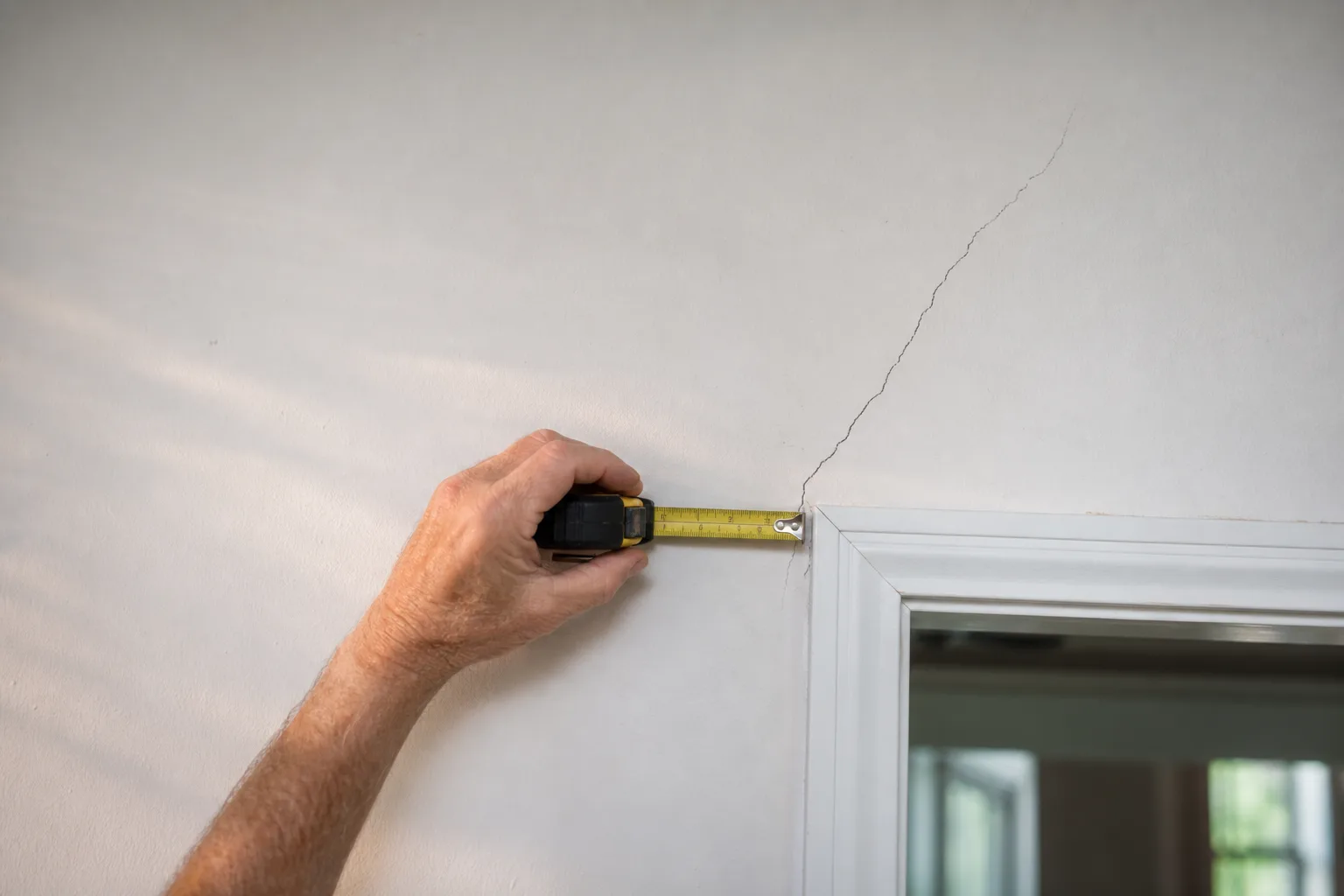
There's a crack climbing out of your bedroom doorway, and you've been staring at it for a week trying to decide whether it's nothing or the start of something expensive. That instinct is right — because the cracks in a wall fall into two very different camps, and the whole question of whether you grab a putty knife or pick up the phone hinges on telling them apart. Most are harmless. A few are the house talking. Here's how to read the difference before you do anything.
This isn't about repairing a crack — we cover the technique for that in drywall crack repair that won't come back. This is the step before: diagnosing what kind of crack you're looking at, so you don't paint over a warning sign or panic over a hairline.
Settling cracks vs structural cracks: the short answer
A settling crack is cosmetic — the normal result of a house easing into place and its framing moving with the seasons. A structural crack is a symptom — the building is being stressed in a way it wasn't designed for, and the crack is just where that stress is showing. You can patch and paint the first. You need eyes on the second before you touch it.
The hard part is that on day one they can look similar. A thin line is a thin line. What separates them is shape, width, location, and behavior over time — and once you know what to read, most cracks sort themselves into the harmless pile fast.
What a normal settling crack looks like
Settling cracks are the everyday cracks, and the overwhelming majority of what you'll see in a home falls here. They come from two ordinary things: a house gradually settling on its foundation over years, and the wood framing behind your drywall swelling through humid Gulf Coast summers and shrinking in the drier winter. Both are normal. Neither is a problem.
You can usually spot a settling crack by these traits:
- Thin — hairline up to roughly an eighth of an inch, often barely wider than a pencil line.
- Follows a seam or a corner — running straight along a taped drywall joint, or fanning out from the upper corner of a door or window where the wall flexes most.
- Vertical or gently angled, not a hard diagonal staircase.
- Stable — about the same width and length it was last year. It opens and closes a hair with the seasons but doesn't march across the wall.
- Alone — no sticking doors, no sloping floors, no cracks repeating in the same direction across several rooms.
Spiderweb patterns of fine cracks in old paint, straight cracks along a ceiling seam, and the classic line out of a doorway corner are all in this family. They're annoying and they reopen if you only smear filler on them, but they're cosmetic. Once you've confirmed a crack is the settling kind, it's a straightforward repair — and that repair lives in our full drywall repair and texture matching guide. When fine cracks have spread across a whole wall, the better fix is often to skim-coat the surface smooth rather than chase each line individually.
Structural crack warning signs
Structural cracks are the minority, but they're the ones worth knowing cold, because patching over one wastes your time and hides a problem that's still growing. These cracks mean something is moving the house more than normal settling — a foundation shifting, a footing settling unevenly, soil moving under the slab, or a load-bearing element under strain.
Watch for these signs:
- Wider than about a quarter inch, or wide enough to slip a coin into.
- A stair-step diagonal — especially on a block, brick, or plaster wall, where the crack tracks the mortar joints in a staircase pattern. That stepped angle is the most reliable tell of structural movement.
- Actively widening — measurably bigger over weeks or months. Pencil-mark the ends and the width with a date and watch it; growth is the loudest signal there is.
- Light or a draft coming through, which means the crack goes clean through the material, not just the surface.
- Company it keeps — doors and windows that suddenly stick or won't latch, floors that slope or feel uneven, gaps opening where trim meets wall, or the same diagonal crack repeating room to room above the same line.
- Horizontal cracks on a foundation or basement-type wall, which can signal pressure pushing the wall inward — among the more serious patterns.
If you see these together, the right next call isn't a painter and it isn't a tube of filler. It's a structural engineer or a foundation specialist who can tell you what's moving and whether it needs to be stabilized. Repairing the drywall first just buys you a fresh crack in the same spot once the movement continues.
| Trait | Settling crack (cosmetic) | Structural crack (investigate first) |
|---|---|---|
| Width | Hairline to ~1/8 inch | Wider than ~1/4 inch |
| Direction | Vertical, or fans from a door corner | Stair-step diagonal, or horizontal on a foundation wall |
| Over time | Stable for years | Visibly widening week to week |
| Location | Along seams and openings | Through walls, repeating across rooms |
| Other signs | None | Sticking doors, sloping floors, gaps at trim |
| What it needs | Tape, float, prime, paint | Engineer or foundation pro before any repair |
How to check a crack yourself in ten minutes
You don't need tools beyond a pencil, a coin, and a phone camera to get a strong read. Most homeowners can sort a crack into the right pile in one sitting.
Measure the width
Hold a coin or a tape against the widest point. Hairline to an eighth of an inch leans cosmetic; a quarter inch or wider leans structural. Note the number so you can compare later.Read the direction
Is it vertical or following a seam, or is it a diagonal staircase? Stair-step cracks that track mortar or run on a hard diagonal are the ones that point at movement, not settling.Check its company
Walk the room. Do doors and windows stick or fail to latch? Does the floor slope or feel uneven near the crack? Are gaps opening where baseboard meets wall? Those neighbors turn a maybe into a yes.Mark it and wait
Pencil a line across each end of the crack and write the date next to it. Check in a few weeks. A crack that hasn't moved is almost surely settling; one that has crept past your marks needs a professional look.Photograph and decide
Snap a dated photo for your records. If it stayed thin and stable and travels alone, plan a normal patch-and-paint. If it's wide, stair-stepped, growing, or keeping bad company, get it assessed before you repair anything.
Why Gulf Coast homes crack the way they do
Our corner of Alabama is hard on walls in a specific way, and it shows up as cracks. The humidity swings are the big one — framing behind your drywall takes on moisture through a wet, sticky summer and gives it back in the drier months, so it's always moving a little. That seasonal flex is exactly what opens the thin seam and doorway-corner cracks you see most. It's also why a crack here can look like it's "growing" when it's really just breathing with the season; watching it over a few weeks sorts the breathers from the genuine movers.
Soil plays a part too. Clay-heavy ground that expands when it's saturated and contracts in a dry spell can nudge a foundation around, and storm-season downpours that soak the ground unevenly don't help. None of that means your house is in trouble — it means the cosmetic cracks are common and the occasional structural one is worth taking seriously rather than assuming "all old houses do that." Older homes around the bay, in particular, have settled for decades; the question is always whether a crack is still moving or finally at rest.
When should you bring in a painter — and when not?
Here's the honest division of labor. A settling crack — thin, stable, traveling alone — is a painter's job, and a good one repairs it so it disappears and stays gone: open it, re-bridge the seam with tape, float it wide, match the texture, prime, and paint. That's our world, and it's part of nearly every interior repaint we do. Wider damage gets a heavier hand — the kind of larger drywall hole and wall resurfacing we handle alongside the repaint. If you've already patched the same line once and it came back, that's usually a technique problem, not a structural one — and fixing nail pops and recurring cracks for good walks through why.
A structural crack is not a painter's job, and any honest painter will tell you so. If the signs above point that way, get a structural engineer or foundation specialist out first. Once whatever was moving is addressed, then the drywall repair and repaint make sense — and not a day before.
When you're not sure which camp you're in, that's a fair reason to have someone who reads walls every day take a look. Pro 1 Painters has been a family-owned Gulf Coast crew since 2013, and telling a settling crack from a structural one is the first thing we do before we ever quote a repair. One accountable crew runs your project from your free estimate through the final inspection, a manager signs off before final payment, and the work is backed by our 3-year workmanship warranty and a 4.8-star reputation. If there's a crack you can't read, book a free in-home estimate for drywall repair and painting and we'll tell you straight whether it's a patch or a "call someone first" — and email a written quote within 24 hours. Pay by Cash, Check, or Credit Card.