
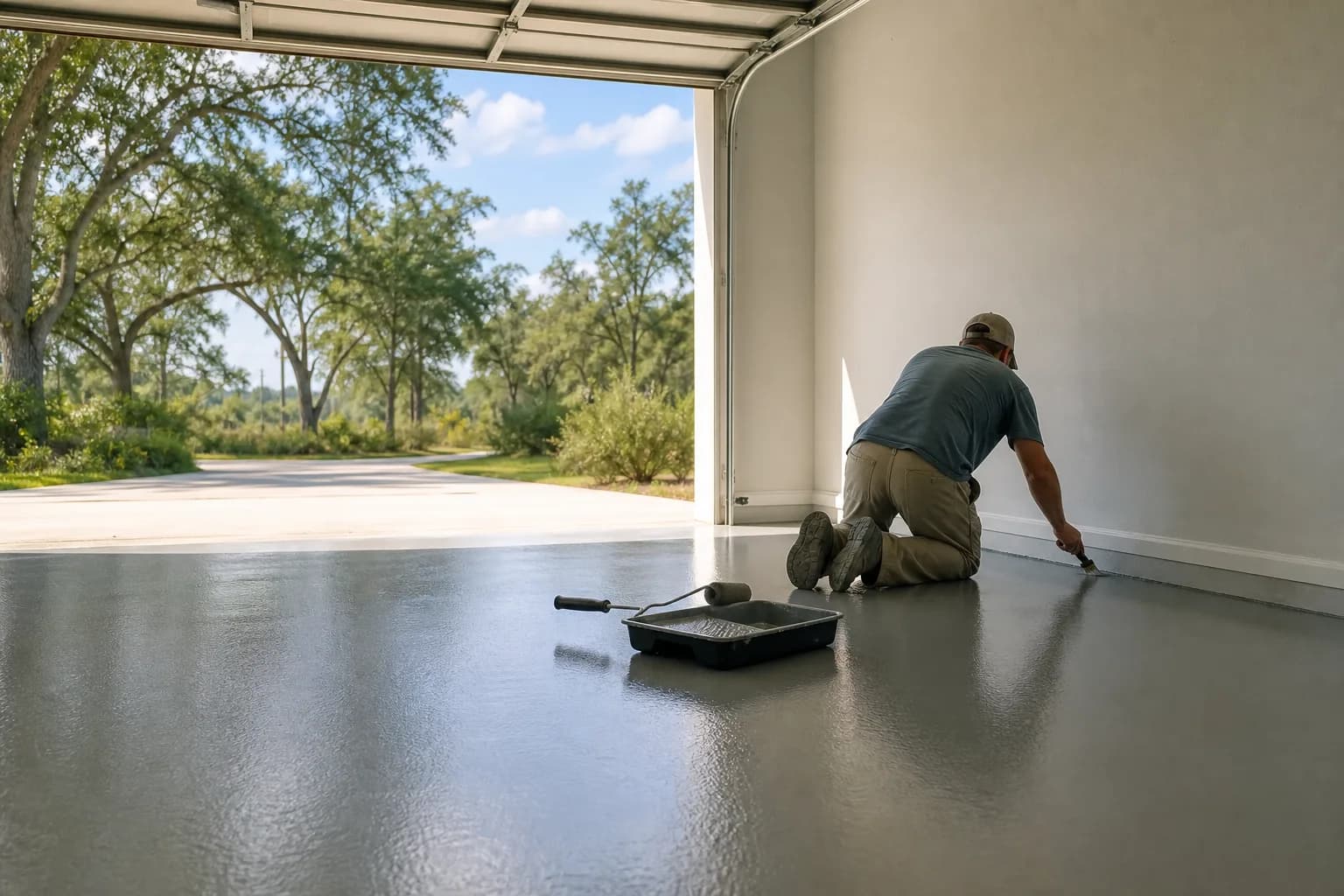
Walk into most garages on the Gulf Coast in August and you can feel the problem before you see it. The slab sweats. The air is thick. And whatever is on that floor — bare concrete, a flaking coat someone rolled on years ago, or nothing at all — lives with heat, humidity, and moisture coming up from the ground. Any honest comparison of epoxy and paint starts with the slab, not the product.
Here's a straight comparison of epoxy vs paint for a garage floor in coastal Alabama — what each one is, where each wins, and the prep that decides whether either lasts.
Epoxy vs paint: what's actually different
The short version: epoxy is a thick, hard, two-part coating that cures into a tough shell. Floor paint is a thinner, flexible finish that refreshes and protects the surface of the slab. They solve overlapping problems at different price points and with very different demands on the prep and the concrete underneath.
Epoxy builds a heavier film, so it resists chemicals, abrasion, and hot-tire pickup better. That toughness comes with strings attached: it's far less forgiving about slab moisture, it demands aggressive prep, and once it fails it tends to fail in sheets that are a real chore to remove. Floor paint costs less, goes down faster, forgives a little more, and is easy to recoat when it wears — but it's a lighter-duty finish that won't take the same punishment.
| Factor | Epoxy | Floor paint |
|---|---|---|
| Upfront cost | Higher | Lower |
| Durability / abrasion | Excellent | Good for light duty |
| Hot-tire pickup resistance | Best when fully cured | Fair — better than bargain paint |
| Tolerance for slab moisture | Low — unforgiving | Higher, but still needs a dry slab |
| Prep demand | Heavy (etch/grind, bone-dry) | Thorough, but less aggressive |
| Recoat / repair later | Harder once it fails | Easy to refresh |
| Best fit | Heavy-use, well-sealed slab | Clean, dry, light-to-moderate-use garage |
Notice what's missing from that table: a clear winner. There isn't one in the abstract. The right pick depends on how hard you use the space and how much the slab will cooperate.
How coastal Alabama makes this decision different
Most garage-floor advice online is written for dry climates. Ours is not one. Two coastal realities drive many floor failures.
Slab moisture. A concrete slab sitting on Gulf Coast soil wicks ground moisture up through itself and releases it as vapor at the surface — year-round, worse in our wet season. Seal that surface with a coating the vapor can't pass through and the pressure builds underneath until it pushes the finish off. That's the bubbling and the lifting sheets people blame on "bad epoxy." Usually it isn't the product. It's vapor with nowhere to go, under a slab that was never moisture-tested.
Heat and humidity during cure. High humidity and heat affect how a floor finish cures, and a finish that did not cure fully is more vulnerable under hot tires or heavy cleaning. Cure time is not optional here.
Where floor paint is the smart, honest choice
For a lot of Gulf Coast garages, a quality painted concrete floor is the right answer — not a compromise. If you mostly walk the space, store things, run a workbench, and park a daily driver on a clean, dry slab, paint gives you a fresh, easy-to-clean, sealed-looking floor for less money, and it refreshes easily when it wears. You're not buying more floor than you need.
Floor paint also has uses beyond the garage. The same general approach can work on a concrete porch or patio floor and on an eligible light-duty shop floor where you want a clean, finished surface rather than an industrial coating. Those non-garage surfaces are the lane our floor painting service covers.
To be clear: Pro 1 Painters does not paint garage floors and does not install epoxy or coating systems. A garage slab should be evaluated by a contractor who offers garage-floor work. Pro 1 paints eligible porches, patios, interior concrete, and commercial or shop floors.
The prep that makes either finish last
Here is the part that decides everything, and it is the same truth whether you go epoxy or paint: the bond is only as good as the prep. A premium product over a greasy, sealed, or damp slab can fail early; a suitable product over a properly prepared slab has a much better chance of holding.
Degrease the whole slab
Strip out the oil, brake dust, and grime ground into the concrete. Coating over invisible grease is the number-one reason a garage floor finish lets go.Open the surface (etch or profile)
Smooth, sealed concrete has nothing for a finish to grip. Acid-etch or mechanically profile the slab so the coat can bite into the pores.Confirm the slab is dry
Run the plastic test and let any moisture issue settle before coating. In our climate this step gets skipped — and it's the one that comes back to bite.Patch and clean
Fill cracks and spalls, then vacuum every speck of dust so the finish bonds to concrete, not to debris.Apply and let it fully cure
Lay the finish in proper conditions and — this is the one people rush — give it full cure time before you walk it, then longer before you park on it.
Skip the moisture test and you risk bubbling. Skip the degrease or the etch and you risk peeling. Park a hot car on it too soon and you risk the tires lifting it. None of those are product failures. They're prep-and-patience failures, and they're exactly the failures we're built to avoid.
So, epoxy or paint?
If you've got a clean, dry, light-to-moderate-use garage and you want a sharp, sealed floor without overspending, floor paint is usually the right call — and it's easy to refresh down the road. If you run a genuinely heavy-abuse space on a verified-dry slab and you want maximum toughness, epoxy earns its higher cost and its tougher prep. Either way, the slab and the prep decide the outcome far more than the bucket does.
For a garage floor, hire a contractor who offers and warrants garage-floor work. For a concrete porch, patio, eligible interior, or commercial or shop floor, see our floor painting service and commercial painting guide. When you're ready, book a free estimate and we will inspect the eligible surface and put the scope in writing.